

Most people search poquito meaning expecting a quick one-liner: “a little.” And sure, that’s technically correct. But the second you hear a native Spanish speaker drop poquito into a real conversation, you realize something much richer is happening.
This word doesn’t just measure quantity — it softens tone, signals warmth, and marks a speaker as someone who truly gets the language. This guide covers everything: etymology, grammar, gender rules, regional flavor, real-world usage, and the key distinctions that most learners miss.
Where Does Poquito Even Come From?
To understand poquito, you need to understand what Spanish does with the -ito suffix — one of the most productive tools in the entire language.
Spanish uses diminutives constantly. When you attach -ito or -ita to the end of a word, you do more than shrink it. You add emotional coloring: affection, warmth, politeness, or gentle softening. Perro (dog) becomes perrito (little dog, or affectionately, doggy). Café becomes cafecito (a nice little coffee). The diminutive doesn’t just describe size — it changes the feel of the word.
Poquito works the same way. The base word is poco, meaning “little” or “a small amount.” Add the -ito suffix and you get poquito — but notice something: it isn’t pocito. The spelling shifts to poquito because Spanish preserves the hard c sound before the i. Without the qu, the word would be mispronounced. This is a standard phonological rule in Spanish spelling.
The heavy use of diminutives — especially in Latin American Spanish — was also reinforced over centuries by indigenous languages like Náhuatl, which already had rich diminutive structures. In Mexico particularly, poquito is far more common in everyday speech than its base form poco.
What Poquito Actually Means in Spanish vs. English
Poquito translates most directly as:
- A tiny bit
- Just a little
- A very small amount
- A wee bit (in tone, if not in literal translation)
In English, we lack a single word that carries the same emotional weight. “A little” is neutral. Poquito is warm. That warmth is the gap translation can never fully close.
Here’s how it appears in everyday Spanish sentences:
| Spanish | English |
|---|---|
| Quiero dormir un poquito más. | I want to sleep a little bit more. |
| Tengo un poquito de hambre. | I’m just a little bit hungry. |
| Hay un poquito de agua en el vaso. | There’s a tiny bit of water in the glass. |
| ¿Puedes bajarle un poquito? | Can you turn it down just a little? |
| Habla un poquito de español. | He/she speaks just a tiny bit of Spanish. |
Notice that in every case, the word does double duty: it conveys a small quantity and softens the statement. Saying tengo hambre (I’m hungry) is blunt. Tengo un poquito de hambre is almost apologetic — lighter, more conversational.
Also Read This: LYR Meaning — What It Actually Stands For in Texts and Online
The Poco vs. Poquito Gap Nobody Talks About
This is where most Spanish guides fall short. They treat poco and poquito as perfect synonyms — interchangeable, just a matter of style. That’s not quite right.
Poco = a little (neutral)
Poquito = a tiny little bit (warmer, more intimate, more emphatic about smallness)
Think of it this way: poco is the baseline. Poquito adds emphasis on the smallness of the amount, and simultaneously softens the delivery.
In practice:
- If you ask a waiter for un poco de sal, that’s a reasonable, polite request.
- If you ask for un poquito de sal, you’re signaling extra politeness — almost as if you don’t want to impose. It can come across as more considerate, more endearing.
In Mexican Spanish especially, poquito has largely replaced poco in casual speech. You’ll hear it constantly. Many native speakers from Mexico will use poquito even when they genuinely mean a moderate amount — the diminutive has evolved into a default register for informal conversation.
And it doesn’t stop there. Spanish allows stacked diminutives for emphasis. Poquito can become poquitito — and if you really want to emphasize just how tiny the amount is, some speakers will stretch it further to poquititito. Each added layer signals: “I mean very little.”

Gender Agreement — The Part Most Guides Skip
Here’s a grammar rule that often gets glossed over: poquito agrees in gender with the noun it modifies.
The forms are:
| Form | Use |
|---|---|
| poquito | masculine singular |
| poquita | feminine singular |
| poquitos | masculine plural |
| poquitas | feminine plural |
Most of the time, you’ll encounter un poquito because it’s used as an adverb (modifying a verb or adjective) or with masculine/neuter nouns. But when it modifies a feminine noun directly, the form shifts:
- Tengo un poquito de tiempo → time (tiempo) is masculine → poquito ✓
- Hace un poquita de frío → frío is masculine → actually poquito here too ✓
- Llegaron poquitas personas → personas is feminine plural → poquitas ✓
This is the agreement rule that most learners — and even many teachers — skip. In practice, un poquito works as a fixed adverbial phrase in most contexts. But if you’re using it as an adjective modifying a feminine noun, make the switch to poquita.
Poquito in Actual Conversations
Seeing poquito in a dictionary sentence is one thing. Hearing how it functions in genuine back-and-forth exchange is another. Here are real conversational contexts where it naturally appears:
Offering something modestly:
“¿Quieres más?” / “Sí, pero solo un poquito.”
“Do you want more?” / “Yes, but just a tiny bit.”
Asking for a small favor:
“¿Me puedes esperar un poquito?”
“Can you wait for me just a little?”
Describing your skill level:
“Hablo un poquito de español.”
“I speak just a little Spanish.”
Expressing mild discomfort (without drama):
“Me duele un poquito la cabeza.”
“My head hurts just a little.”
Requesting an adjustment:
“¿Le puedes subir un poquito al volumen?”
“Can you turn the volume up just a bit?”
In each example, poquito communicates more than quantity. It communicates social register — the speaker is being careful not to ask for too much, not to exaggerate, not to impose. That’s the social function that makes this word so common in real speech.
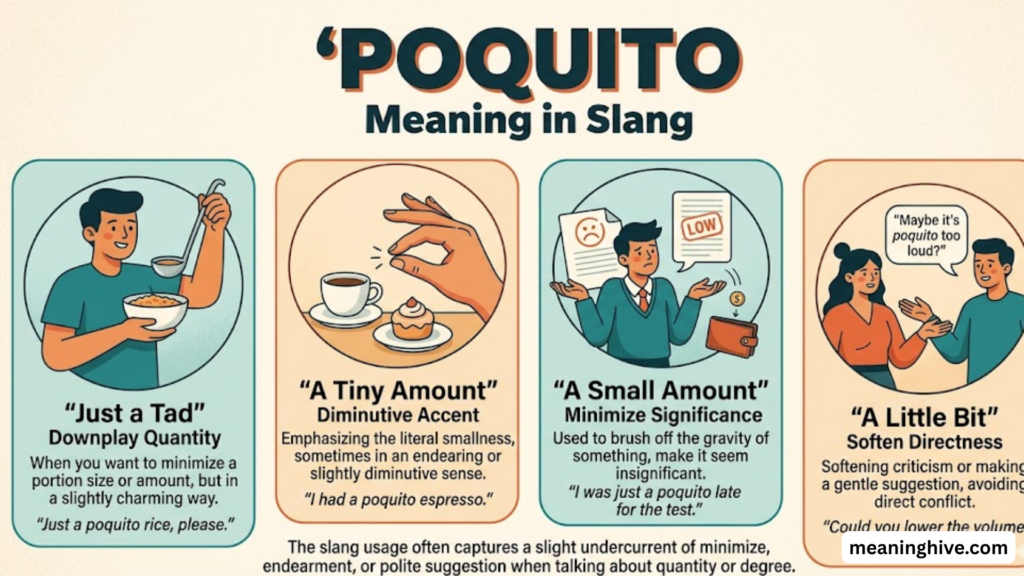
Poquito Meaning in Slang — What People Are Actually Looking For
When people search for poquito meaning in slang, they’re often thinking of one specific phrase: “poquito loco” — a tiny bit crazy. This phrase appears in pop culture, social media captions, and casual banter.
Used playfully, poquito loco doesn’t mean dangerously unhinged. It means fun, spontaneous, delightfully unpredictable. It’s an affectionate label someone might put on themselves or a close friend.
Other culturally prominent uses:
- “Poquito a poquito” — little by little; gradually. This phrase implies patient, steady progress. It was also the title of a popular Henry Santos bachata song (2011), which brought the phrase into wider pop-culture awareness.
- “Un poquito más” — just a little more; used both literally (more food, more time) and figuratively (more effort, more love).
- “Solo un poquito” — only a little; often used self-deprecatingly or playfully to downplay something.
These phrases feel light and warm — that’s the poquito effect in action.
Poquito Phrases That Actually Come Up in Real Life
These are the expressions you’ll encounter frequently in Spanish-speaking communities:
| Phrase | Literal Meaning | Actual Usage |
|---|---|---|
| un poquito | a tiny bit | Softened request or description |
| poquito a poquito | little by little | Steady, patient progress |
| solo un poquito | only a little bit | Downplaying a feeling or amount |
| un poquito más | just a little more | Asking for slightly more |
| espera un poquito | wait just a little | Asking someone to be patient |
| poquito loco/loca | a little crazy | Playful self-description |
| un poquito cansado/a | a little tired | Mild complaint without drama |
| habla un poquito | speaks a little | Describing beginner-level language |
Each phrase follows the same emotional logic: reduce the intensity of the statement, add warmth, and signal humility or lightness. Once you internalize that core function, using poquito naturally becomes much easier.
Poquito vs. Pequeño — A Confusion Worth Clearing Up
This is one of the most common mix-ups among Spanish learners, and it’s understandable — both words can translate to “little” in English. But they are not interchangeable.
Here’s the essential distinction:
Pequeño = small in physical size or age
Poquito = small in amount, degree, or quantity
| Sentence | Correct Word | Why |
|---|---|---|
| I have a small house. | pequeña (casa pequeña) | Describes physical size |
| I have very little space. | poquito (poquito espacio) | Describes amount of space available |
| He’s a small child. | pequeño (niño pequeño) | Refers to age/size |
| He speaks very little. | poquito (habla poquito) | Refers to quantity/degree |
Think of it this way: the opposite of pequeño is grande (big). The opposite of poquito is mucho (a lot). That rule alone will save you from most errors. You would never say tengo poquito casa to mean “I have a small house” — the word simply doesn’t fit that role.
Pequeño is always an adjective describing a physical attribute. Poquito works as both an adjective (modifying nouns of quantity) and an adverb (modifying verbs and adjectives). They live in different grammatical lanes.
Solo un Poquito in English
The phrase “solo un poquito” translates directly as “just a little bit” or “only a tiny bit.” It’s one of the most practical phrases in casual Spanish conversation.
You’ll hear it in contexts like:
- Solo un poquito de azúcar, por favor. — Just a tiny bit of sugar, please.
- Estoy solo un poquito nervioso. — I’m only a little bit nervous.
- Llegué tarde, solo un poquito. — I was late, just a little bit.
The word solo (only/just) amplifies the smallness even further. It’s the equivalent of saying “barely any” or “hardly at all” — with a gentle, non-defensive tone.
Why Poquito Is Worth Getting Right
A single word rarely makes or breaks your Spanish fluency. But poquito is the kind of word that native speakers notice — not because you use it incorrectly, but because when you use it correctly, you instantly sound more natural.
Using poco constantly in casual conversation is technically fine. But reaching for poquito in the right moments — softening a request, expressing mild discomfort, showing politeness — is one of those quiet signals that separate textbook Spanish from lived Spanish.
It also opens the door to understanding how Spanish diminutives work at a deeper level. Once you understand why poquito feels warmer than poco, you start to hear cafecito, momentito, ahorita, and dozens of other everyday diminutives with fresh ears. You stop treating them as decoration and start recognizing them as emotional signals.
Pronunciation note before you go: it’s po-KEE-toh. Three syllables, stress on the second. Get that right and you’re already halfway to sounding natural.
FAQs
What does poquito mean in English?
It means “a tiny bit,” “just a little,” or “a very small amount” — with added emotional warmth that a plain translation can’t fully capture.
What is the difference between poco and poquito?
Poco means “a little” (neutral); poquito is the diminutive form meaning “a tiny little bit,” with a softer, warmer tone.
How do you pronounce poquito?
Po-KEE-toh. Three syllables, stress falls on the middle one.
Is poquito masculine or feminine?
It agrees with the noun it modifies: poquito (masculine), poquita (feminine), poquitos/poquitas (plurals).
What does “solo un poquito” mean in English?
It means “just a little bit” or “only a tiny amount” — commonly used to downplay or soften a statement.
What does “poquito loco” mean?
It means “a little crazy” — typically used playfully or affectionately rather than literally.
What is the difference between poquito and pequeño?
Pequeño refers to physical size; poquito refers to quantity or degree. They are not interchangeable.
Is poquito used in formal Spanish?
Not typically. It’s informal and conversational. In formal writing or speech, poco is the preferred form.
What does “poquito a poquito” mean?
It means “little by little” — a phrase describing gradual, steady progress.
What language is poquito from?
Spanish. It is the diminutive form of poco, formed with the standard Spanish -ito suffix.
