

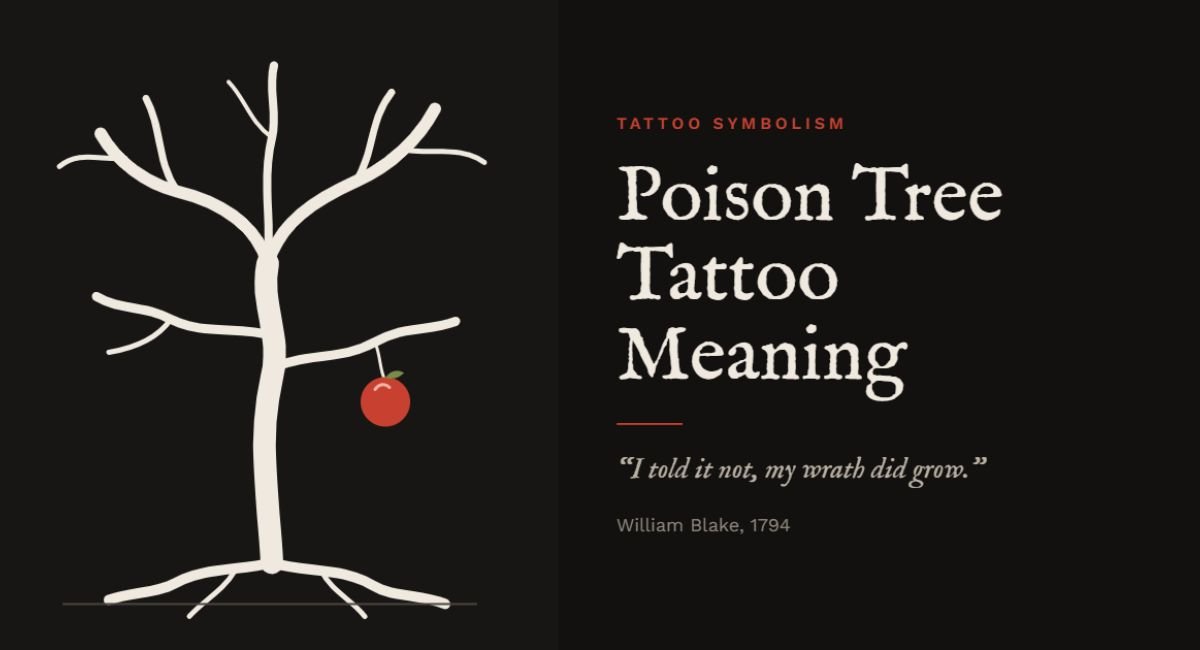
Your coworker rolls up her sleeve, and there it is: a twisted black tree, roots curling like fingers, with one glossy red apple hanging from a bare branch. It’s beautiful in a way that feels slightly threatening. You want to ask about it, but you’re not sure whether you’re about to hear a breakup story or a poetry lecture.
Honestly? It could be both.
The poison tree is one of those designs that looks like simple gothic decoration. It actually carries a 230-year-old story about anger, secrecy, and what happens when you let a grudge grow. Like a [[tree of life tattoo]], its meaning lives in the details.
Here’s what it really means.
What Does a Poison Tree Tattoo Mean?
Quick Answer: A poison tree tattoo usually symbolizes suppressed anger, a grudge, or a toxic emotion that grew because it was hidden. It comes from William Blake’s 1794 poem “A Poison Tree.”
The fuller picture depends on who’s wearing it. For some people it’s a warning to themselves: don’t bottle things up again. For others it marks a toxic relationship they survived. A few wear it with a mischievous edge, as if to say, “I don’t forget.”
The details change the message. A tree with a single shining apple points straight at Blake. A tree with a body or skull beneath it leans into revenge. A tree blooming with flowers alongside the poison often signals healing: something good grew out of something bitter.
Some ways people describe their own ink:
- “It reminds me that the silence was the problem, not the fight.”
- “Got it after leaving a relationship that slowly poisoned me.”
- “It’s my petty tattoo. I grow my grudges organically.”
Origin and History
The design traces back to William Blake, the English poet and painter. He published “A Poison Tree” in Songs of Experience in 1794, and the poem is short enough to quote in full here:
I was angry with my friend;
I told my wrath, my wrath did end.
I was angry with my foe:
I told it not, my wrath did grow.
The speaker waters his anger with fears and tears and sunshines it with fake smiles. The anger grows into a tree that bears “an apple bright.” The enemy steals the apple at night, and in the morning the speaker finds him “outstretched beneath the tree.”
Blake’s notebook draft carried a far more ironic title, “Christian Forbearance.” That title shows his target: polite, smiling restraint that hides hatred underneath.
Here’s the insight most tattoo articles miss: in Blake’s poem, the speaker grows the tree. The poison isn’t someone else’s toxicity. It’s the speaker’s own unspoken anger. People often get this tattoo to represent a toxic ex or a betrayal, but the original text points the finger inward. That gives the design a striking honesty. It’s one of the few popular tattoos that can mean “I was the problem too.”
Other “poison tree” traditions likely feed the imagery:
- The Upas tree: a Javanese tree that 18th-century European writers wildly exaggerated as killing everything for miles around. It became a stock image of deadly influence in literature.
- The manchineel tree: a real Caribbean tree whose sap and fruit are genuinely toxic, often nicknamed the “little apple of death.”
- “Fruit of the poisonous tree”: a US legal doctrine that evidence gathered illegally taints everything that follows. Justice Felix Frankfurter used the phrase in Nardone v. United States (1939). Some law students and lawyers wear the design as an inside joke.
- The Garden of Eden: the apple-on-a-tree image inevitably echoes the forbidden fruit, even though Blake never names it.
There’s no single documented moment when the poison tree became a popular tattoo. It most likely spread through literature lovers, gothic and blackwork styles, and later Pinterest and TikTok aesthetics. Its meaning has stayed remarkably stable: anger that festers when it’s hidden.
How the Poison Tree Tattoo Shows Up Across Platforms
TikTok
On TikTok, the design often appears in “story behind my tattoo” videos. The tone tends toward emotional reveals: the creator shows the ink, then explains the relationship or experience behind it. A typical style of caption: “Got this after I finally stopped pretending I was fine.”
Instagram is where tattoo artists showcase the design, usually in fine-line, blackwork, or dark illustrative styles. Captions are short and aesthetic, often quoting a single Blake line. Example style: “My wrath did grow 🍎🖤”
Pinterest is the planning stage. People save poison tree boards alongside botanical, gothic, and literary tattoo ideas. The tone is quiet and inspirational. Example pin title style: “Dark literary tattoo ideas for book lovers.”
On tattoo and poetry subreddits, the design sparks deeper discussion about interpretation, placement, and whether the poem is really about revenge or self-awareness. Example style: “Is it weird to get a poison tree if I’m the one who held the grudge?”
Tumblr-style blogs and book communities
Literary fandom spaces treat the poison tree as a badge of English-class nostalgia and dark academia aesthetics. Example style: “Blake tattoo club, roll call.”
| Platform | Common Use | Tone | Example |
|---|---|---|---|
| TikTok | Tattoo story reveals | Emotional, confessional | “Got this after I stopped pretending I was fine.” |
| Artist portfolios, aesthetic posts | Stylish, minimal | “My wrath did grow 🍎🖤” | |
| Design inspiration boards | Quiet, aspirational | “Dark literary tattoo ideas” | |
| Interpretation debates | Thoughtful, curious | “Is it weird if I’m the one who held the grudge?” | |
| Book communities | Literary identity | Nerdy, nostalgic | “Blake tattoo club, roll call.” |
What It Means to You vs. What Others See
Here’s the awkward part about meaningful tattoos: you know the story, but strangers only see the picture.
To the wearer, a poison tree might mean healing, honesty, or a hard lesson learned. To a stranger, a dark tree with a dead figure underneath can read as “this person holds grudges” or even “revenge fantasy.” Neither reading is wrong. Blake built the poem on exactly that ambiguity.
In real life, people with this tattoo often get asked about it. A quick, ready answer helps, such as “It’s from a William Blake poem about bottling up anger.” That one line instantly shifts the vibe from menacing to thoughtful.
Examples in Sentences
Friendly/Casual
- “Is that a poison tree tattoo? I studied that poem in school!”
- “She got a poison tree on her forearm. Apparently it’s about her old job.”
- “I want something literary but dark, maybe a poison tree?”
Sarcastic/Humorous
- “Don’t make me add your name to my poison tree.”
- “My poison tree tattoo is fully watered and thriving, thanks for asking.”
Online/Caption Use
- “Planted this one years ago. Finally let it go. 🌳”
- “Fresh ink: Blake’s poison tree, fine-line style.”
- “Told my wrath this time. Keeping the tree as a reminder.”
Variations and Related Designs
Common variations of the poison tree tattoo include:
- Single red apple: the most direct Blake reference, often the only color in a black design.
- Body beneath the tree: a literal nod to the poem’s final line, darker and more revenge-focused.
- Tree with exposed roots: emphasizes how deep the grudge or trauma runs.
- Half-dead, half-blooming tree: represents recovery from toxicity.
- Text-only version: the line “I told it not, my wrath did grow” in script, with no tree.
Related designs worth knowing:
| Term | Meaning | Similar/Different |
|---|---|---|
| [[Tree of life tattoo]] | Connection, growth, family, continuity | Different: positive and life-affirming |
| [[Dead tree tattoo]] | Loss, grief, endings | Similar darkness, but about loss rather than anger |
| [[Snake and apple tattoo]] | Temptation, sin, forbidden knowledge | Similar imagery, but rooted in Eden, not Blake |
| Deadly nightshade tattoo | Danger, beauty with a sting | Similar “beautiful but toxic” theme |
| Thorn and rose tattoo | Love mixed with pain | Similar duality, softer tone |
| Blake “Tyger” tattoo | Creation, fear, awe | Same poet, different poem and message |
When to Choose It (and When to Think Twice)
CHOOSE IT WHEN…
- The Blake poem genuinely resonates with you
- You want a reminder to express anger honestly instead of burying it
- You’ve survived a toxic relationship or situation and want to mark that growth
- You love dark, literary, or botanical tattoo styles
THINK TWICE WHEN…
- You want it purely as a “revenge” statement about a specific person; feelings change, ink doesn’t
- You’ll need to explain a body-under-the-tree design in conservative workplaces often
- You’re choosing it only because it looks cool and don’t care about the meaning (there are lighter tree designs)
- You’d prefer a tattoo whose meaning reads instantly as positive to strangers
Conclusion
A poison tree tattoo is about what happens when anger goes unspoken: it grows, quietly and dangerously, until it bears fruit. That’s why it resonates with so many people who’ve stayed silent too long.
Some of the most enduring tattoos aren’t the happiest ones. They’re the ones that tell the truth. If you love meaning-rich nature designs but want something brighter, the [[tree of life tattoo]] makes a fascinating counterpart.
FAQ
What does a poison tree tattoo literally represent?
It represents a tree grown from hidden anger, based on William Blake’s 1794 poem “A Poison Tree.” The tree’s bright, deadly apple symbolizes the harm a secret grudge eventually causes.
Is a poison tree tattoo a bad omen or a threat?
Not usually. Most people wear it as a reminder about emotional honesty or as a mark of surviving something toxic. Versions with a body beneath the tree can read as darker, so context and design choices matter.
Is it the same as a forbidden fruit or Eden tattoo?
No, though the imagery overlaps. Eden tattoos focus on temptation and sin, while the poison tree is about anger that grows when it’s suppressed.
Is a poison tree tattoo appropriate for professional settings?
A subtle version, like a small tree with one apple, is generally fine in most workplaces. More graphic designs with skulls or bodies may draw questions, so placement is worth considering if that matters to you.
When did the poison tree tattoo become popular?
The poem dates to 1794, but there’s no clear record of when it became a tattoo trend. Its visibility grew alongside dark academia, fine-line tattoo styles, and tattoo-story content on TikTok and Instagram.

1 thought on “What Does a Poison Tree Tattoo Mean? The Dark Truth Behind the Bright Apple”