

You’ve seen it in a text message, spotted it in a dating app bio, or heard it tossed around in conversation — FWB. But what does it actually mean? And why does the term seem to carry slightly different weight depending on who’s using it and where?
This guide breaks down everything you need to know about FWB — from its definition and how it works in real relationships, to its use across social platforms, its pros and cons, and even what FWB means in medical and pregnancy contexts. Whether you’re genuinely curious or actively navigating one, you’re in the right place.
FWB Meaning: What Are Friends With Benefits?
FWB stands for “Friends With Benefits.” At its core, it describes a relationship where two people who are already friends also engage in physical intimacy — without the commitment, exclusivity, or emotional expectations that come with a traditional romantic partnership.
Think of it this way: you genuinely like the person, you enjoy spending time together, there’s real chemistry — but neither of you wants to label it as a relationship or work toward a shared future. That middle space is FWB territory.
Unlike a one-night stand, an FWB arrangement typically continues over time with a degree of mutual comfort and trust. Unlike dating, it lacks the emotional investment and shared goals that romantic relationships involve.
Key Characteristics of an FWB Relationship
- Existing friendship as the foundation — trust and familiarity already exist
- Physical intimacy included — though the nature of this varies between pairs
- No romantic commitment or exclusivity (unless both parties agree otherwise)
- Ongoing arrangement — not a one-time encounter
- Open communication required to keep things running smoothly
Differences Between FWB and Dating
Many people confuse FWB with casual dating, situationships, or even no-strings-attached arrangements. Here’s how they actually differ:
| Term | Emotional Bond | Commitment | Ongoing? | Social Element |
|---|---|---|---|---|
| FWB | Friendship-level | None | Yes | Limited |
| Casual Dating | Low to moderate | None | Often | Yes (dates, outings) |
| Situationship | Ambiguous | Unclear | Yes | Sometimes |
| NSA | Minimal | None | Not always | Rarely |
| ONS (One Night Stand) | None | None | No | No |
| Dating (Relationship) | Deep | Full | Yes | Yes |
The clearest distinction is this: FWB starts from friendship. There’s already a bond there. Casual dating often starts from attraction and slowly builds a connection. A situationship is an undefined grey zone that neither person has labelled — often because one or both are afraid to.
Also Read This: SMH Meaning: What It Stands For and How to Use It
FWB Meaning in Text Messages
When someone uses “FWB” in a text message, they’re almost always referring to the Friends With Benefits dynamic. Common examples you might see:
- “Not looking for anything serious, just FWB honestly.”
- “We’ve been FWB for a few months — it’s chill.”
- “Thinking about asking him if he wants to be FWB?”
In texting slang, FWB is used both as a noun (“she’s my FWB”) and as a descriptor (“we’re FWB”). It signals intentional casualness — a way of communicating that the relationship is physical but not emotionally entangled.
You’ll also see it written as:
- fwb (lowercase — more casual)
- F.W.B. (formal usage)
- fwbr — Friends With Benefits Relationship (less common)
The tone is typically light and matter-of-fact. Using the abbreviation in text is a way to communicate intent clearly without making things awkward.
FWB as Slang in Social Circles
Beyond one-on-one texting, FWB has become embedded in modern social vocabulary — especially among young adults and Gen Z. You’ll see it in:
- Instagram bios — “not looking for labels, open to FWB”
- TikTok captions and comments — often used humorously or to describe past situations
- Snapchat — used in chats or stories to describe casual connections
- Reddit threads — relationship advice communities use it extensively
- Group chats — friends referencing someone’s FWB casually
What’s interesting is that FWB isn’t always used negatively or as something secret. For many people, it’s a legitimate and openly discussed relationship style — especially in urban, progressive social circles where traditional dating timelines are no longer the default.
How FWB Works in Dating
An FWB arrangement doesn’t just happen — it typically moves through recognizable stages:
Stage 1: Friendship
The foundation is already there. You know this person, you trust them, and there’s an unspoken chemistry that’s been building.
Stage 2: The Conversation
Someone brings it up. This is the most crucial part. An honest conversation about what both people want — and don’t want — makes or breaks the arrangement before it even begins.
Stage 3: Setting Boundaries
What does this look like in practice? Are you exclusive or free to see others? Do you hang out socially? How do you handle it if feelings develop? These questions need answers upfront.
Stage 4: The Ongoing Dynamic
Things progress. This is where regular communication matters most. Check-ins — even brief ones — help both people stay aligned.
Stage 5: Re-evaluation
Life changes. Feelings shift. At some point, most FWB arrangements evolve: they either become a committed relationship, fade naturally, or end when circumstances change. Research suggests that roughly 40% of FWB relationships eventually transition into romantic partnerships.
Pros of FWB: Benefits
FWB arrangements work well for specific people in specific circumstances. Here’s why people genuinely choose this path:
- No pressure or obligation — you can focus on career, personal goals, or healing without relationship demands
- Physical intimacy with someone you trust — unlike hookup culture, there’s real familiarity
- Emotional comfort without full commitment — companionship without the weight of a formal relationship
- Honest communication practice — FWB requires directness, which builds communication skills
- Freedom to pursue other connections — unless both agree otherwise, there’s no exclusivity requirement
- Can be a healthy transitional arrangement — for people coming out of long-term relationships or not ready to commit
Cons of FWB: Drawbacks
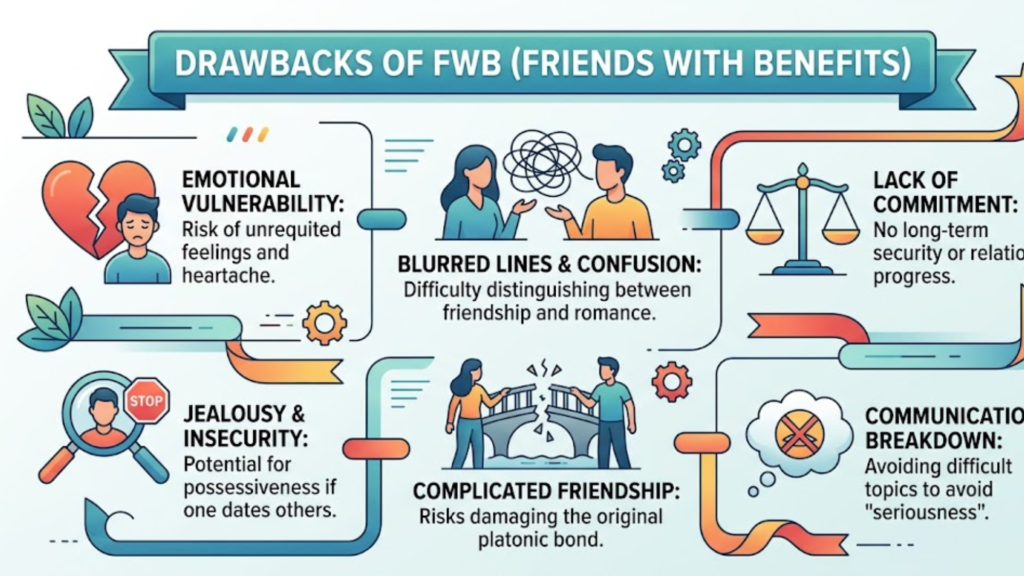
For all its appeal, FWB comes with real risks that shouldn’t be minimized:
- Emotional imbalance — one person almost always develops deeper feelings before the other, leading to hurt
- Jealousy — seeing your FWB pursue or be with someone else can trigger unexpected emotions
- Friendship damage — if things go wrong, the original friendship often doesn’t survive intact
- Ambiguity creep — without clear boundaries, the arrangement slowly starts feeling like a relationship without the label or security
- Social awkwardness — mutual friends may not understand the dynamic, leading to unwanted questions or pressure
- Unequal expectations — without regular communication, each person may assume different things about where they stand
FWB and Emotional Health
This is perhaps the most important section of this guide — and the one most often glossed over.
FWB arrangements are not emotionally neutral by default. For some people, they genuinely work well and leave both parties feeling respected and fulfilled. For others, they quietly erode confidence, create anxiety, and lead to longer-term emotional confusion.
Signs the Arrangement May Be Affecting You Negatively
- You feel anxious between meet-ups or when they don’t text back
- You’ve started checking their social media more than you’d like to admit
- You downplay your own feelings to seem “cool” with the arrangement
- You’re hoping they’ll eventually want more — but haven’t said so
- You feel worse about yourself after seeing them, not better
When FWB Supports Emotional Well-Being
- Both people are genuinely on the same page
- Communication is honest and frequent
- Neither person is secretly hoping for more
- There’s mutual respect and care — not just physical interaction
- Both people feel free to end it without fear of conflict
If you’re unsure which category you fall into, that uncertainty itself is usually telling you something important.
Rules and Boundaries in FWB Relationships
FWB doesn’t have to be chaotic. Clear rules actually give these arrangements the best chance of staying positive for both people. Consider discussing:
Essential Boundaries to Set
- Exclusivity — Are you both free to see other people? If so, do you tell each other?
- Public behaviour — Do you act as friends in social settings, or is it more than that?
- Communication frequency — How often is too much? How little is too cold?
- Emotional check-ins — Agree upfront to be honest if feelings change
- End terms — What happens if one person meets someone else? How do you wind it down respectfully?
- Safe sex — Non-negotiable (more on this below)
The most successful FWB arrangements are those where both parties feel they can speak openly without fear of judgment or losing the connection.
Safe Sex and FWB
Physical safety in any intimate arrangement is non-negotiable — and FWB is no exception.
Because FWB relationships often exist in a casual framework, it can be tempting to skip the harder conversations about sexual health. Don’t. Here’s why it matters:
- STI transmission risk — regular physical intimacy with someone who may also be seeing others increases exposure
- Unplanned pregnancy — relevant to any heterosexual FWB arrangement
- Consent — must be clear, ongoing, and enthusiastic every single time
Safe Sex Essentials in FWB
- Use barrier methods (condoms) consistently
- Discuss contraception openly if applicable
- Get tested regularly — ideally every 3–6 months if sexually active with more than one person
- Be honest about your sexual health history and any new partners
Having this conversation early — before things get physical — is part of what separates a healthy FWB from a risky one.
FWB on Snapchat
Snapchat’s disappearing message format has made it a natural home for FWB dynamics. The platform’s built-in ephemerality takes some of the pressure off — messages vanish, stories expire, and nothing has to feel “official.”
On Snapchat, FWB often looks like:
- Late-night “wyd?” snaps
- Casual check-ins without the pressure of a full conversation
- Bio phrases like “not looking for anything serious 😉” or “FWB vibes only”
- Streaks maintained as a low-key way of staying connected
The Snapchat FWB culture exploded between 2023 and 2025 as more creators began openly discussing casual relationship styles. It’s normalized among younger users, though it can blur lines quickly when one person starts reading more into the consistency of contact than the other intended.
FWB on Grindr
Within the LGBTQ+ community, FWB has a well-established and broadly accepted meaning. On Grindr specifically, the term is used explicitly and transparently — users often list it directly in their profiles to signal what they’re open to.
Common Grindr FWB profile language includes:
- “Looking for FWB or NSA”
- “FWB only — no drama”
- “Down for something casual/FWB”
What makes Grindr’s FWB culture distinct is the directness. There tends to be less ambiguity around labelling because the app’s format encourages upfront communication about intentions. The FWB arrangement on Grindr is often genuinely respected as a valid relationship style — not a stepping stone to something else unless both parties want it to be.
Related Terms: NSA, ONS, and FWB
Understanding FWB also means knowing how it relates to other common slang in modern dating:
| Term | Full Form | What It Means |
|---|---|---|
| FWB | Friends With Benefits | Friends who are also physically intimate — ongoing |
| NSA | No Strings Attached | Purely physical — no friendship, no emotional layer |
| ONS | One Night Stand | Single encounter, no ongoing contact expected |
| DTR | Define the Relationship | The conversation where two people clarify what they are |
| Situationship | — | Undefined quasi-relationship — emotionally involved but unlabelled |
The key difference between FWB and NSA is friendship. NSA is purely transactional. FWB includes mutual care, shared jokes, real comfort with each other — it’s just not romantically committed. The difference between FWB and a situationship is clarity. FWB is intentionally defined as casual. A situationship is undefined — and that ambiguity is usually the source of its tension.
Is FWB Right for You?
FWB works well for some people and poorly for others. It’s not a character flaw if it’s not for you — it requires a specific emotional bandwidth to navigate healthily.
FWB May Work For You If:
- You genuinely don’t want a committed relationship right now
- You’re emotionally secure and don’t tend toward attachment anxiety
- You can communicate openly and honestly, even when it’s uncomfortable
- You respect the other person and genuinely care about their well-being
- You’re okay with the arrangement ending without it meaning something was wrong
FWB Probably Isn’t For You If:
- You secretly hope it turns into more
- You struggle with jealousy when a partner sees others
- You need emotional security from a partner to feel comfortable
- You have difficulty expressing your needs or enforcing your own boundaries
- You’ve been in FWB situations before that ended painfully and nothing has changed
Being honest with yourself about which category you’re in before entering an FWB is the most important decision in the whole equation.
Alternatives to FWB
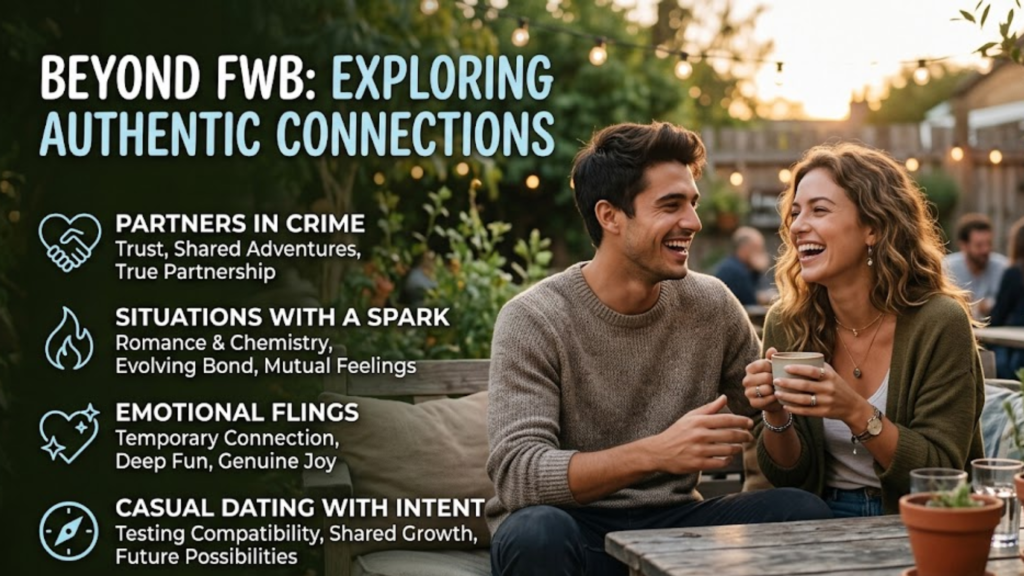
If FWB doesn’t feel right — or if you’ve tried it and it didn’t serve you — there are other arrangements worth considering:
- Casual dating — get to know someone without the pressure of commitment, but with more structure than FWB
- Open relationships — committed partnership that allows both people to see others
- Exclusive dating (“talking stage”) — exclusive without a formal label, but with the emotional trajectory of a relationship
- Celibacy or intentional singleness — choosing to focus entirely on yourself for a defined period
- Traditional committed relationships — if you want love, security, and a future — that’s completely valid
There is no universally correct relationship style. What matters is choosing honestly — not based on what seems cool or low-maintenance, but based on what actually aligns with who you are.
FWB Meaning in Chat
In chat contexts specifically — WhatsApp, Instagram DMs, iMessage — FWB carries its standard meaning but the tone shifts based on platform and conversation history. In a casual group chat among friends, someone mentioning their FWB is entirely normal. In a new conversation with someone you just matched with, it signals immediate intent about what they’re looking for.
Context clues to watch for:
- If used early in a new conversation, it’s signalling casual interest without commitment
- If used in the middle of an ongoing dynamic, it may be a gentle attempt to define what’s happening between you
- If someone asks “are we FWB?” — that’s a DTR (define the relationship) moment, and deserves an honest answer
One practical note: emojis often soften the tone. “Looking for fwb 😊” reads differently from “FWB only.” Pay attention to the whole message, not just the acronym.
FWB Meaning in Pregnancy
Here’s where FWB takes on an entirely different meaning — and one that confuses a lot of people who encounter it in a medical or prenatal context.
FWB in Pregnancy = Fetal Well-Being
In obstetrics and prenatal care, FWB stands for Fetal Well-Being. It refers to assessments made during pregnancy to evaluate how well the baby is developing and whether the pregnancy is progressing safely.
A USG FWB (Ultrasound Sonography Fetal Well-Being) is a specific type of prenatal scan that checks:
- Fetal size and estimated weight
- Amniotic fluid levels
- Placental position and function
- Fetal heart rate and movement
- Blood flow (via Doppler studies in some cases)
- Overall biophysical profile of the baby
This scan is typically recommended in the third trimester or when a doctor has specific concerns about the pregnancy. It’s a routine tool for monitoring high-risk pregnancies, assessing growth restriction, or verifying fetal health when movement patterns change.
FWB in Physical Therapy = Full Weight Bearing
In physiotherapy and rehabilitation settings, FWB has yet another meaning: Full Weight Bearing. This term indicates that a patient recovering from a bone fracture, joint surgery, or lower limb injury has been cleared to put their full body weight on the affected limb without restriction.
The progression typically goes:
- NWB — Non-Weight Bearing (no pressure on the limb)
- TTWB — Toe-Touch Weight Bearing (toes only, no load)
- PWB — Partial Weight Bearing (some pressure permitted)
- WBAT — Weight Bearing As Tolerated
- FWB — Full Weight Bearing (fully cleared)
Reaching FWB status in recovery is a milestone — it marks the point where healing is advanced enough for normal walking and daily activities.
Frequently Asked Questions (FAQs)
What does FWB mean?
FWB stands for Friends With Benefits — a friendship that includes physical intimacy without romantic commitment.
What does FWB mean in a text message?
In texting, FWB signals that someone wants a casual, physical connection with a friend — no labels, no obligations.
Is FWB the same as casual dating?
No. FWB starts with an existing friendship; casual dating involves meeting new people and going on dates without commitment.
Can FWB turn into a real relationship?
Yes — studies suggest around 40% of FWB arrangements do transition into committed relationships, though this depends heavily on both people’s feelings evolving equally.
What does FWB mean on Snapchat?
On Snapchat, FWB usually signals interest in a casual, low-pressure arrangement — often communicated through late-night snaps or bio phrases.
What does FWB mean on Grindr?
On Grindr, FWB refers to a casual, no-strings intimate arrangement between two people — it’s openly listed in profiles and widely understood within the LGBTQ+ community.
What is NSA vs FWB?
NSA (No Strings Attached) is purely physical with no friendship involved. FWB includes real friendship, care, and familiarity alongside physical intimacy.
What does FWB mean in pregnancy?
In pregnancy, FWB stands for Fetal Well-Being — a prenatal scan (USG FWB) that monitors the baby’s development, heart rate, and overall health.
What does FWB mean in medical terms?
In physiotherapy, FWB means Full Weight Bearing — a stage of recovery where a patient can place full pressure on an injured or post-surgical limb.
How do you set up an FWB arrangement?
Start with an honest conversation about expectations, boundaries, exclusivity, and what happens if feelings change. Clear communication from the start is the single biggest predictor of whether an FWB works.
What are the biggest risks of FWB?
Developing unequal feelings, jealousy, blurred boundaries, and damage to the original friendship are the most common challenges.
Conclusion
FWB is one of the most widely used terms in modern relationship vocabulary — and one of the most misunderstood. Whether you’re trying to decode a message, decide if it’s the right arrangement for you, or simply understand what someone means when they use the term, the key is context.
In relationships and dating, FWB works best when both people are genuinely on the same page, communicate openly, and respect each other’s emotional well-being. It’s not inherently good or bad — like most things in life, its value depends entirely on how honestly it’s approached.
In pregnancy and medical contexts, FWB means something entirely different — and knowing that distinction can prevent a lot of unnecessary confusion.
Whatever brought you here, the most important takeaway is this: clarity and honesty — with yourself and the other person — are the foundation of any arrangement that actually works.
