

If you’ve ever received a message that just says “SMH” and stared at your phone wondering what it means, you’re not alone. Internet slang can feel like a whole new language — especially when abbreviations like SMH pop up everywhere from WhatsApp group chats to TikTok comment sections. In this guide, you’ll find everything you need to know about SMH: what it stands for, when to use it, how different people use it across platforms, and the most common mistakes to avoid. By the end, you’ll be using it like you’ve known it all along.
What Does SMH Mean in Simple Words
In the simplest terms, SMH means “Shaking My Head.”
It’s the text version of that moment when something so ridiculous, frustrating, or disappointing happens that all you can do is slowly shake your head. You don’t need to write a paragraph explaining your feelings — three letters say it all.
Think of it as a digital eye-roll. When words fail, SMH steps in.
Example:
“He showed up an hour late and didn’t even apologize. SMH.”
That one line tells you everything about how the sender feels — without any extra explanation needed.
The Full Form of SMH and Its Real Meaning
The full form of SMH is “Shaking My Head.”
It’s an internet slang acronym that captures the physical gesture of shaking your head side to side — which in real life signals disbelief, disappointment, or disapproval. Online, it translates that exact same emotion into text.
While “Shaking My Head” is the most widely accepted and recognized meaning, SMH does have a few alternative interpretations that show up in niche contexts:
| Abbreviation | Full Form | Emotion Conveyed |
|---|---|---|
| SMH | Shaking My Head | Disbelief, frustration, disappointment |
| SMH | So Much Hate | Negativity or criticism toward someone |
| SMH | Scratching My Head | Confusion or puzzlement |
| SMH | So Much Hype | Excitement or over-promotion |
| SMDH | Shaking My Damn Head | A stronger, more intense version of SMH |
Unless the conversation clearly points to another meaning, SMH almost always means “Shaking My Head.”
When and Why People Use SMH Online
People use SMH whenever they encounter something that triggers a mild to moderate emotional reaction — usually one of these four:
- Disappointment — when someone lets you down or makes a poor choice
- Disbelief — when something is so unbelievable you can’t quite process it
- Frustration — when a situation is just too annoying to put into words
- Mild mockery — when something is so silly it deserves a gentle tease
It became popular because it’s fast, emotionally loaded, and universally understood online. Instead of typing “I can’t believe that just happened” or “That’s so disappointing,” users just drop “SMH” and move on. It fits perfectly into the short-form, fast-paced culture of digital communication.
It first appeared in early internet forums and chat rooms in the late 1990s and early 2000s. By the time social media exploded between 2010 and 2015, SMH had gone fully mainstream.
Also Read This: JOI Meaning Slang: The Ultimate 2026 Guide
What SMH Expresses in Text Messages
In text messages, SMH functions as a reaction word — similar to “wow,” “seriously?” or “come on.” It tells the other person exactly how you feel without requiring a long explanation.
Here’s what SMH typically expresses in a one-on-one text conversation:
- “I’m disappointed in you (or this situation)”
- “I can’t believe this is happening”
- “This is frustrating but I’m not furious”
- “That was a dumb move”
What makes SMH unique is its tone range. Depending on the context, it can be:
- Lighthearted and funny — used between close friends laughing at something absurd
- Mildly serious — expressing genuine disappointment
- Sarcastically exasperated — “Of course this happened. SMH.”
The emoji you pair with SMH often controls the tone. SMH 😂 feels playful. SMH 😔 feels more sincere. SMH 💀 is pure Gen Z exasperation humor.
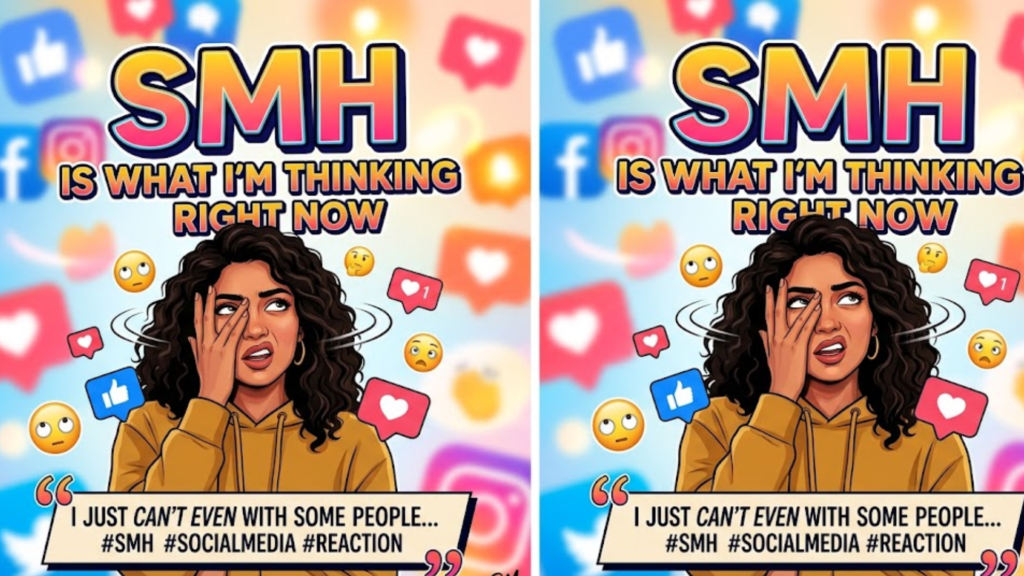
How SMH Is Used on Social Media Platforms
SMH shows up differently across platforms, but the core meaning stays the same. Here’s a quick breakdown:
On Instagram, SMH appears in comments reacting to posts, Reels, or stories that show something surprising, cringeworthy, or hard to believe. It’s often used under viral content where a simple reaction is more powerful than a lengthy comment.
Example comment on a post about a canceled event: “They sold out tickets for this? SMH 😒”
TikTok
TikTok is where SMH thrives. Users drop it in comments reacting to chaotic, unbelievable, or funny videos. It’s also used in video captions themselves — creators use it to frame their own content with a self-aware or disappointed tone.
Caption: “Me after forgetting my lunch at home for the third time this week… smh 💀”
Snapchat
On Snapchat, SMH appears in quick back-and-forth chats as a fast emotional reaction to something a friend shares — a snap, a meme, or a piece of gossip.
Twitter / X
On Twitter, SMH is commonly used in quote tweets or replies to add a layer of disapproval or exasperation to someone else’s post, especially during internet drama, political news, or viral moments.
Is SMH Serious or Just for Fun?
The honest answer: it depends on the context.
SMH sits in a flexible middle ground. It’s rarely used for deeply serious situations — you wouldn’t respond to genuinely bad news with “SMH.” But it’s also not always joking around.
Here’s a rough guide:
| Situation | Tone of SMH |
|---|---|
| Friend forgets plans again | Lighthearted / playful |
| Reacting to a dumb internet trend | Humorous exasperation |
| Someone makes a poor life decision | Mild judgment / concern |
| Responding to a frustrating news story | Genuine disappointment |
| Sarcastic reaction to obvious drama | Ironic / amused |
The key is reading the rest of the message. If someone writes “SMH, you’re impossible 😂,” they’re teasing. If someone writes “SMH. I’m really disappointed,” the tone shifts.
Real-Life Chat Examples of SMH
Here are some realistic conversations showing exactly how SMH is used:
Example 1 — Forgetting Something
A: “I left my charger at home again.” B: “Bruh, SMH 😭”
Example 2 — Bad Decision
A: “He quit his job without having another one lined up.” B: “SMH. What was he thinking?”
Example 3 — Funny Frustration
A: “The pizza place sent me the wrong order AGAIN.” B: “SMH 💀 at this point just cook at home”
Example 4 — Reacting to News
A: “Did you see they raised the ticket prices again?” B: “SMH. Every single year.”
Example 5 — Self-Directed
“Locked myself out of the house. SMH at myself.”
SMH vs OMG vs WTF: Easy Comparison
These three are some of the most popular reaction acronyms in texting. Here’s how they differ:
| Acronym | Full Form | Emotion | Intensity | Tone |
|---|---|---|---|---|
| SMH | Shaking My Head | Disappointment / disbelief | Low to medium | Calm, judgmental |
| OMG | Oh My God | Shock / excitement | Medium to high | Energetic, surprised |
| WTF | What The F*** | Disbelief / anger | High | Intense, shocked |
| SMDH | Shaking My Damn Head | Stronger disappointment | Medium to high | Exasperated |
| LOL | Laugh Out Loud | Amusement | Low to medium | Light, playful |
When to use which:
- Use SMH when you’re disappointed but not explosive about it.
- Use OMG when something genuinely surprises or excites you.
- Use WTF when something shocks or angers you intensely.
Mixing them up can send the wrong signal — SMH is measured; WTF is explosive. They are not interchangeable.
How Gen Z Commonly Uses SMH
Gen Z has made SMH their own. While older generations use it fairly literally — to express disappointment — Gen Z layers it with irony, humor, and self-awareness.
For Gen Z, SMH often carries a tone of amused resignation — like “of course this happened, I’m not even surprised anymore.” It’s less about genuine anger and more about the comedic frustration of everyday absurdity.
Common Gen Z SMH patterns:
- Paired with “💀” (skull emoji): The ultimate combo for “I’m dead from how ridiculous this is.” “SMH 💀” = peak Gen Z exasperation humor.
- Lowercased “smh”: Typing in lowercase gives it a more casual, tired energy — like you can’t even be bothered to capitalize.
- Self-directed SMH: Gen Z freely uses it on themselves. “Bought another plant I’m definitely going to kill. smh.”
- Used in video captions: On TikTok and Instagram Reels, creators use “smh” in captions to frame chaotic or relatable content.
- Combined with “bruh”: “Bruh smh” or “smh bruh” is a classic Gen Z double-tap of exasperation.
For Gen Z, SMH is as natural as punctuation. It’s less of a deliberate choice and more of a reflex.
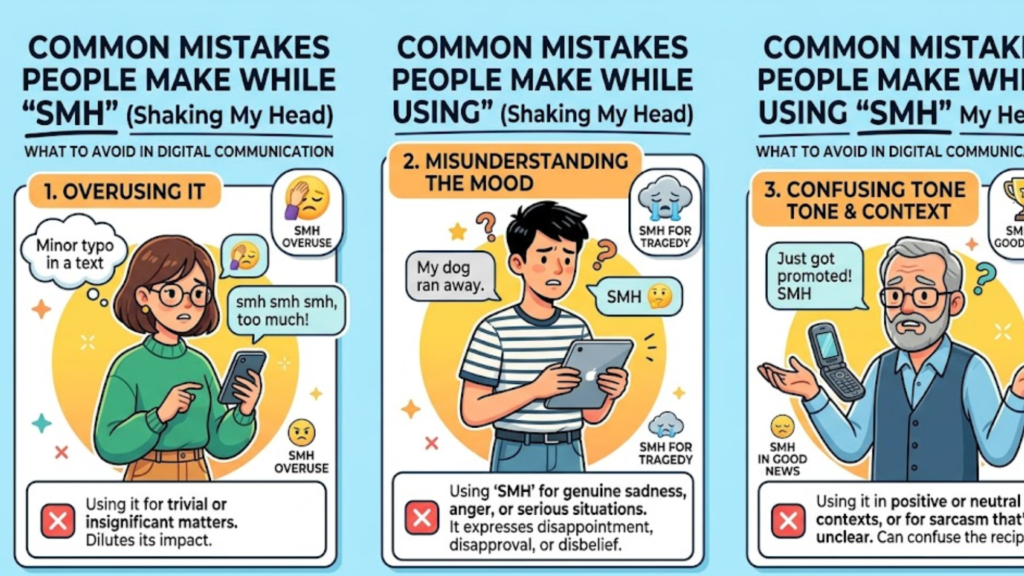
Common Mistakes People Make While Using SMH
SMH is simple, but there are a few ways people get it wrong:
1. Using it in formal or professional settings SMH is pure casual slang. Never use it in a work email, professional message, or academic context. It will come across as unprofessional or confusing to someone unfamiliar with internet slang.
2. Confusing it with LOL SMH and LOL are very different. LOL is amusement — you’re laughing. SMH is disappointment or disbelief — you’re shaking your head. Using SMH when you mean LOL can make you sound judgmental when you meant to sound amused.
3. Overusing it Like any expression, SMH loses its impact when used in every message. Reserve it for moments that actually call for that reaction.
4. Using it in sensitive conversations If someone shares genuinely difficult news or a personal struggle, responding with “SMH” can come across as dismissive or cold. Read the room.
5. Assuming it always means anger SMH is not an angry expression. It’s a mild-to-moderate reaction. Using it in place of something stronger (like expressing real anger) can confuse the tone of your message.
SMH Meaning in WhatsApp
On WhatsApp — whether in personal chats or group conversations — SMH works as a fast emotional reaction. It’s especially common in group chats where people share news, gossip, memes, or funny moments and others react quickly without writing full sentences.
In WhatsApp specifically:
- It’s used to react to something someone shared in the chat without derailing the conversation.
- In family groups or mixed-age groups, some members may not recognize it — so context helps.
- It’s often paired with voice notes or stickers for extra emphasis.
- In GCC and South Asian WhatsApp communities (including Pakistan and India), SMH has crossed language barriers and is used even by non-native English speakers who picked it up through memes and social media.
WhatsApp group chat example: Someone shares a news article about rising prices. Reply: “SMH every month it gets worse 😩”
SMH Meaning in Chat “Somehow”
Here’s a nuanced point that trips some people up: in certain online conversations — especially older forums or niche communities — “smh” has occasionally been interpreted or used to mean “somehow.”
This is not a widely accepted or standard meaning. It typically happens when:
- Someone misreads or misremembers the abbreviation.
- It appears in older message logs where context was ambiguous.
- Someone uses it jokingly or ironically.
For example:
“He smh managed to break a brand new laptop in one day.”
In this sentence, the user likely meant “somehow” — but this is a non-standard usage. If you see “smh” used mid-sentence like an adverb, the writer probably means “somehow.” In every other context, assume it means “shaking my head.”
SMH Meaning in Chat Tagalog
In Filipino internet culture, SMH has been adopted just like other English internet slang — and Filipino speakers use it in a mix of English and Tagalog (a style known as Taglish).
In Tagalog-influenced chat conversations, SMH is used exactly as it is in English — to express dismay, disbelief, or frustration — but often mixed into sentences with Filipino words.
Taglish examples:
“Grabe naman ‘yan, SMH.” (That’s unbelievable, SMH.)
“Nag-late na naman siya. SMH talaga.” (He was late again. Truly SMH.)
“Yung ganun ka-simple na bagay hindi pa niya magawa. SMH.” (Something that simple and he still can’t do it. SMH.)
Filipino Gen Z and millennials use SMH casually in Facebook comments, Twitter replies, group chats on Messenger, and TikTok comment sections. The meaning doesn’t change — it’s still a head shake of disbelief or disappointment. The language around it just shifts into Taglish.
Conclusion
SMH is one of those internet acronyms that has stood the test of time — and for good reason. In just three letters, it captures a deeply human reaction: that slow, disbelieving shake of the head when reality disappoints you. Whether you’re reacting to a friend’s questionable decision, venting in a WhatsApp group, or dropping a comment on a chaotic TikTok video, SMH does the job quickly and clearly.
The key takeaways: SMH stands for “Shaking My Head,” it expresses disappointment, disbelief, or frustration, it’s used across all major platforms, and it should stay in casual conversations — not professional ones. Used at the right moment, it’s a perfectly expressive piece of modern language.
Frequently Asked Questions (FAQs)
Q: What does SMH stand for? A: SMH stands for “Shaking My Head” and is used to show disappointment, disbelief, or frustration.
Q: Is SMH positive or negative? A: SMH is mostly negative or neutral — it expresses mild disapproval, not excitement or praise.
Q: Can SMH be used sarcastically? A: Yes, SMH is often used sarcastically, especially by Gen Z, to express amused or ironic exasperation.
Q: What is SMDH? A: SMDH means “Shaking My Damn Head” — a more intense version of SMH.
Q: Is it okay to use SMH in formal writing? A: No — SMH is casual slang and should never appear in professional emails, academic writing, or formal communication.
Q: What does SMH mean in WhatsApp? A: On WhatsApp, SMH is used as a quick reaction to express disbelief or frustration about something shared in a chat.
Q: What does SMH mean in Tagalog chats? A: Filipino users use SMH in Taglish (Tagalog + English) the same way — to express dismay or disappointment, mixed naturally into Filipino sentences.
Q: Does SMH ever mean “somehow”? A: In rare, non-standard usage, some people use SMH to mean “somehow,” but this is not widely accepted. The standard meaning is always “Shaking My Head.”
Q: How is SMH different from WTF? A: SMH is calm and mildly disappointed; WTF is intense shock or anger. They are not interchangeable.
Q: When did SMH start being used? A: SMH originated in early internet forums and chat rooms in the late 1990s to early 2000s, going fully mainstream with the rise of social media around 2010–2015.
