

Introduction
Two letters. That’s all your friend sent: “fo.” No context, no emoji, no follow-up. Was that a typo? A cut-off word? Or did they just tell you to get lost?
Here’s the strange part. “FO” is one of the few slang terms that can be friendly or hostile depending on how it’s written and where it sits in a sentence. In one message it’s a relaxed way of saying “for.” In another, it’s a blunt, rude dismissal.
If you’ve already figured out terms like [[fr]], you’re halfway there. Let’s sort out exactly which “FO” you’re dealing with.
What Does FO Mean?
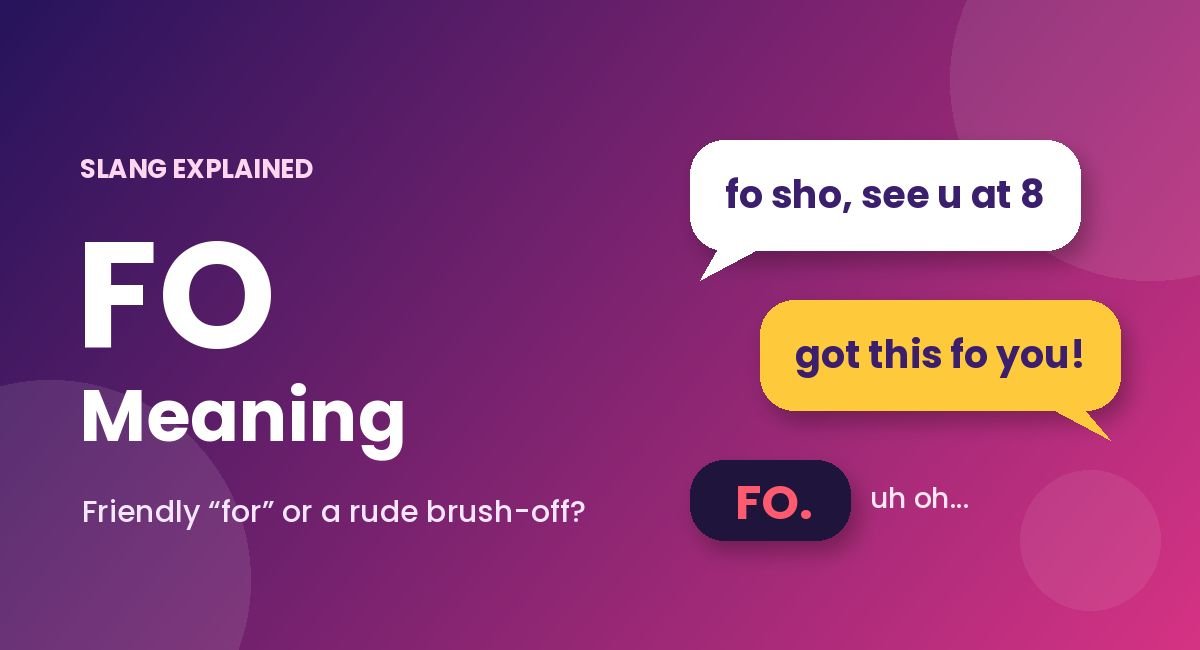
Quick Answer: “Fo” usually means “for,” a casual spelling that copies how the word sounds in relaxed speech (“fo real,” “fo sho”). As an all-caps standalone reply, “FO” can also be an abbreviation for “f* off.”**
The most common version is the friendly one. People type “fo” instead of “for” to sound relaxed and conversational. It shows up in phrases like “fo real” (for real), “fo sho” (for sure), and “this is fo you” (this is for you).
The other meaning is much less pleasant. When someone replies with a lone “FO,” especially after an argument or an annoying message, they’re usually telling you to go away, in harsher words.
Context does most of the work here. Compare these:
- “Fo sho, I’ll be there at 8.” — friendly agreement
- “Got a gift fo you 🎁” — warm and playful
- “FO.” (sent after you’ve texted them five times) — not a gift
A useful rule: if “fo” is attached to other words and the vibe is easy-going, it means “for.” If it stands alone as a reply in a tense moment, assume the rude version.
Origin and History
The “for” version comes from spoken English, particularly African American Vernacular English (AAVE), where “for” is often pronounced closer to “fo.” That pronunciation moved into hip-hop lyrics, then into casual writing as people tried to capture how phrases actually sound.
Phrases like “fo sho” and “fo real” became widely recognized through rap music in the 1990s and early 2000s. The playful variant “fo shizzle” is strongly associated with Snoop Dogg, who helped push the “-izzle” style of slang into mainstream pop culture around that era.
From there, the spelling slid into early internet chat rooms, instant messaging, and text messages. Social media later gave it a second life, especially in comments and captions where sounding casual matters more than spelling correctly.
The “f*** off” abbreviation has a murkier history. Like many profanity acronyms, it likely grew naturally out of early online forums and texting culture, where people shortened swear words to save characters or soften them slightly. There’s no clear single starting point, and it’s honest to say nobody can pin down exactly when it began.
What’s interesting is that the meaning of the friendly “fo” hasn’t really shifted. It has always meant “for.” What changed is who uses it, moving from a specific speech community to a broad, mainstream online audience.
How FO Is Used Across Platforms
TikTok
On TikTok, “fo” mostly appears in comments as part of “fo real” or “fo sho.” It’s used to agree with a creator or hype someone up. The tone is playful and supportive.
Example style: “This recipe is fo real the best one I’ve tried 😭”
Instagram users drop “fo” into captions and DMs to sound relaxed. You’ll often see it in captions dedicated to friends or followers.
Example style: “Dropping this one fo the day ones 💛”
Twitter/X
Twitter/X is where both meanings appear. You’ll see “fo real” in casual takes, but you’ll also see “FO” as a rude standalone reply during heated arguments.
Example style: “FO with that take, it’s terrible.”
Discord and Gaming Chats
In gaming chats, speed rules. “Fo sho” is a quick yes, while a sharp “FO” can show up when someone’s annoyed by a teammate.
Example style: “fo sho, I’ll cover B site.”
On Reddit, “fo” is less common because the community leans toward longer, more structured writing. When it appears, it’s usually ironic or quoted.
Example style: “And then my landlord said ‘fo real this time’ about fixing the heater. Sure.”
| Platform | Common Use | Tone | Example |
|---|---|---|---|
| TikTok | “Fo real” in comments | Supportive, playful | “This is fo real genius” |
| Captions and DMs | Warm, casual | “Fo my besties 💛” | |
| Twitter/X | Both meanings | Casual or hostile | “FO with that” |
| Discord/Gaming | Quick agreement or annoyance | Fast, blunt | “fo sho, on my way” |
| Ironic or quoted use | Sarcastic | “‘Fo real this time’ lol” |
Texting vs. Real Life: Spoken Use
Here’s an observation that surprises people. “Fo” doesn’t actually save much effort. It’s just one letter shorter than “for.” So people aren’t really using it for speed.
They use it for voice. Typing “fo” is a way of making text sound like someone talking, carrying a relaxed rhythm that “for” doesn’t have. It’s less of an abbreviation and more of a tone marker.
Out loud, nobody says “F-O” for the friendly meaning. They just say “fo sho” or “fo real” naturally, as part of speech. That’s where the phrase came from in the first place.
The rude version is different. People rarely say “F-O” out loud as letters. If someone wants to say it in person, they’ll usually just say the full phrase. The abbreviation exists mainly as a typed shortcut that feels slightly less harsh on screen.
Examples in Sentences
Friendly/Casual
- “Fo sho, I’ll bring the snacks.”
- “You coming tonight? Fo real, don’t bail again.”
- “Made this playlist fo you, no skips.”
Sarcastic/Humorous
- “Oh yeah, I’m totally waking up at 5 a.m. to work out. Fo sho. 🙃”
- “My phone at 2% says it’s fo real dying this time.”
Online/Caption Use
- “Fo the ones who stayed 🤍”
- “Fo real though, how is it already October?”
- “Sunday reset, fo the soul.”
Variations and Related Slang
The friendly “fo” has a few common variations:
- Fo sho / Fo sure — for sure, absolutely
- Fo real — for real, seriously
- Fo shizzle — a playful, older version of “fo sho”
- Fo’ (with apostrophe) — older spelling showing a dropped letter
Related slang worth knowing:
- [[fr]] — short for “for real,” the modern text version of “fo real”
- [[fs]] — short for “for sure,” a quick way of agreeing
- [[ong]] — “on God,” used to swear something is true
- Bet — “okay” or “deal,” used to agree
- Say less — “I’m in, no need to explain”
- Nah fr — “no, seriously,” adds emphasis
| Term | Meaning | Similar/Different |
|---|---|---|
| Fo real | For real, seriously | Same meaning as “fr,” but fully spelled |
| Fr | For real | Shorter, more modern version |
| Fo sho | For sure | Similar to “fs” and “bet” |
| Fs | For sure | More neutral, less playful |
| Ong | On God | Stronger, used for swearing truth |
| Bet | Okay, deal | Agreement, but more casual than “fo sho” |
Appropriateness and Context Note
Because “FO” can stand for “f*** off,” it’s worth being careful with it.
The friendly “fo sho” and “fo real” are harmless in casual settings. But a standalone “FO” can come across as offensive, even if you didn’t mean it that way.
There’s also a cultural point worth respecting. The “fo” spelling comes from AAVE. Using it naturally among friends is common, but exaggerating it as a joke or caricature can come across badly. Use it the way people actually use it, not as a costume.
If you’re messaging a parent, child, or coworker, it’s safest to type “for” in full and avoid a standalone “FO” entirely.
When to Use It (and When to Avoid It)
USE IT WHEN…
- You’re texting close friends in a relaxed conversation
- You’re agreeing to plans casually (“fo sho, I’m in”)
- You’re writing playful captions or comments
- The other person already uses similar slang with you
AVOID IT WHEN…
- You’re writing professional emails or work messages
- You’re texting someone who might misread it as rude
- You’re in a heated argument, where “FO” can escalate things
- You’re talking to someone older or unfamiliar with slang
Conclusion
“Fo” mostly means “for,” a casual spelling that brings a spoken, laid-back rhythm into text. But a lone, all-caps “FO” can carry a much ruder message.
It’s a good reminder that online writing isn’t just about saving keystrokes. Often, it’s about trying to make flat text sound like a real voice.
If you like how “fo real” works, you’ll probably find the shorter [[fr]] just as useful in your texts.
FAQ
1. What does “fo” literally mean?
“Fo” is a casual spelling of “for.” It copies how the word sounds in relaxed speech and shows up in phrases like “fo real” and “fo sho.”
2. Is “FO” offensive?
It can be. A standalone, all-caps “FO” often means “f*** off,” which is rude. The friendly “fo” in phrases like “fo sho” isn’t offensive at all.
3. Is “fo real” the same as “fr”?
Yes, both mean “for real.” “Fr” is the shorter, more modern text version, while “fo real” feels a bit more playful and spoken.
4. Can I use “fo” in professional messages?
It’s best not to. In work emails or formal chats, “fo” looks careless, and a standalone “FO” could be read as hostile. Stick with “for.”
5. Where did “fo sho” come from?
It comes from pronunciation patterns in African American Vernacular English and was popularized through hip-hop in the 1990s and early 2000s. Social media later spread it into everyday online slang.
