

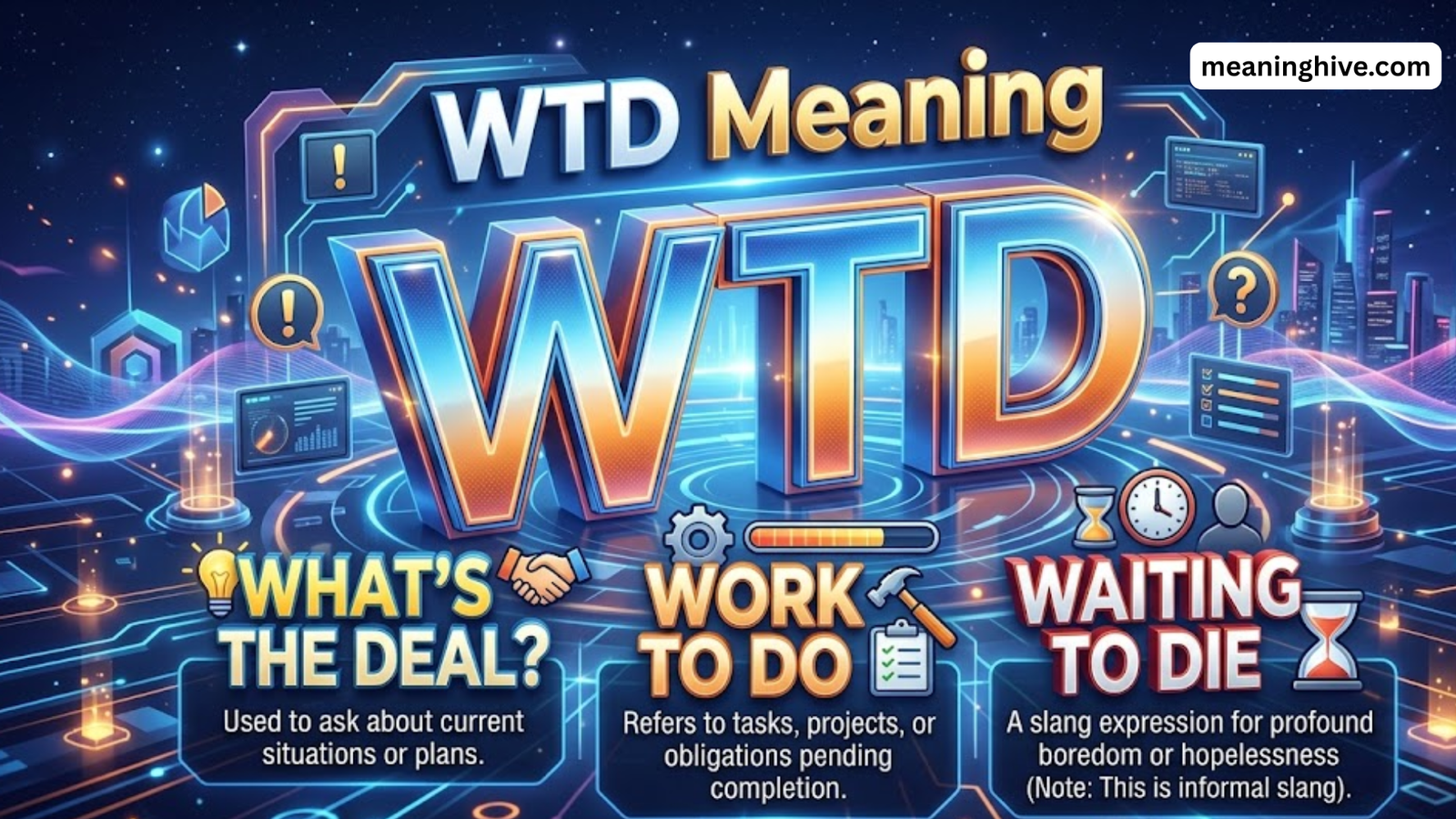
You just got a message that says “WTD?” and now you’re sitting here wondering if your friend needs help, your coworker wants a meeting, or someone is just bored on a Thursday afternoon. The honest answer? It could be any of those. WTD is one of the most context-dependent abbreviations in modern digital communication — and that is exactly what makes it tricky.
This guide breaks down every meaning of WTD, where each version shows up, how to use it correctly, and when to skip it entirely. Whether you’re decoding a text from a friend or reading a business dashboard, you’ll find the right answer here.
You Saw WTD and Got Lost
You are not alone. Thousands of people search “WTD meaning” every day because this abbreviation travels across very different worlds — casual texting, social media, corporate finance, and HR compliance — and it means something different in each one. The confusion is completely normal.
Before we dig into each meaning, here is a quick-reference table:
| Context | WTD Stands For | Example |
|---|---|---|
| Casual texting / slang | What To Do | “It’s Friday night, WTD?” |
| Confused or curious tone | What’s The Deal | “He left without saying bye. WTD?” |
| Business / finance reporting | Week-To-Date | “WTD sales are up 12%” |
| Corporate HR / legal (UK) | Working Time Directive | “Are we compliant with WTD?” |
| Company structure (rare) | Whole Time Director | “WTD compensation was disclosed” |
Read the room — or in this case, read the thread — and the meaning usually becomes obvious within two seconds.
The Bored Version: “What To Do”
The most common WTD meaning in everyday texting is simply “What To Do.” This version pops up when someone is bored, planning something, or asking for input on a situation.
It is a low-effort, high-frequency phrase that fits naturally into casual conversation. You will see it most in group chats and on platforms like WhatsApp, Snapchat, Instagram DMs, and TikTok comments.
Common situations where this version appears:
- Planning the weekend with friends
- Asking for advice when stuck on a decision
- Expressing mild boredom or restlessness
- Checking what the group wants to do next
Real examples:
- “Done with work early. WTD now?”
- “It’s pouring rain and we have three hours. WTD?”
- “He hasn’t texted back in two days. WTD?”
The tone here is light and casual. Nobody typing “WTD?” is in crisis mode — they are just looking for ideas or a quick opinion.
The Confused Version: “What’s The Deal”
The second most common slang interpretation is “What’s The Deal.” This version carries a slightly different energy. Where “What To Do” is about seeking a plan, “What’s The Deal” is about seeking an explanation.
Think of it as a casual, abbreviated way of saying “what is going on here?” or “can someone explain this to me?”
You’ll typically see this when:
- Something unexpected just happened
- A situation seems off or confusing
- Someone is mildly irritated and wants answers
- Plans changed without explanation
Real examples:
- “You said 7pm. It’s 7:45. WTD?”
- “The app just deleted all my progress. WTD??”
- “She was fine yesterday and now she’s ignoring me. WTD?”
The question mark often carries the emotional weight here. One question mark is curious. Two question marks is frustrated. Pay attention to those small signals when you read this version.
How This Plays Out in Real Texts
Seeing WTD in a screenshot is one thing. Understanding how naturally it fits into real back-and-forth conversation is another. Here are a few realistic exchanges:
Scenario 1 – Weekend planning:
Alex: “It’s Saturday and it’s only 2pm.” Jordan: “I know. WTD?” Alex: “Movies? Or just chill somewhere?”
Scenario 2 – Situation confusion:
Mia: “He cancelled last minute AGAIN.” Sam: “WTD honestly. That’s not okay.”
Scenario 3 – Group chat boredom:
“Just finished the gym. No plans tonight. WTD guys?”
In each case, context does the heavy lifting. The relationship, the platform, and the conversation history all point you to the right meaning before you even finish reading the message.
Also Read This: What Does HY Mean in Text? Hey vs Hell Yeah Explained
When the Vibe Shifts
WTD is informal, which means it is sensitive to tone. Because text strips away vocal cues, the same three letters can land very differently depending on the situation.
A few things to watch for:
- Sarcasm risk: “Oh great, WTD now” can read as dismissive or mocking, even if you meant it sincerely.
- Emotional mismatch: If someone shares something heavy and you reply with “WTD,” it can feel like you are brushing them off.
- Misread frustration: Someone already irritated might read a casual WTD as you not taking them seriously.
The fix is simple: if the situation is emotionally charged or serious, write it out. Save WTD for low-stakes, casual moments where both parties are clearly in the same headspace.
Times to Absolutely Skip It
WTD works great between friends who text the same way. It does not work everywhere. Here are the situations where you should leave it out entirely:
- Professional emails to managers, clients, or stakeholders
- First messages with someone you do not know well
- Sensitive conversations involving personal struggles or difficult news
- Older relatives or contacts who are not active texters
- Cross-cultural communication where slang creates confusion rather than connection
The rule of thumb is simple: if there is any doubt about whether the other person will receive it the way you intend it, just type the actual words.
Say It Different Ways
If WTD feels too vague or you want to match a different tone, here are some alternatives:
| Instead of WTD (What To Do) | Use This |
|---|---|
| Any ideas? | More open and friendly |
| What’s the plan? | Clear and direct |
| What do you think? | Invites their opinion specifically |
| I need suggestions | Signals you genuinely want input |
| Instead of WTD (What’s The Deal) | Use This |
|---|---|
| What’s going on? | Neutral and non-confrontational |
| Can you explain? | Clear request for information |
| What happened exactly? | Shows you want details |
| I’m confused | Honest and disarming |
Real Messages People Actually Send
Here is how WTD shows up in authentic digital communication, not textbook examples:
- “Finished the project two hours early. WTD with all this free time lol”
- “She said yes to the date but now she’s leaving me on read. WTD”
- “Flights are cheap rn. WTD for the long weekend?”
- “The code keeps throwing the same error. WTD at this point”
- “Movie ended. It’s only 9pm. WTD?”
Notice the casual punctuation, the lack of capital letters, and the conversational rhythm. That is what makes WTD feel natural — it lives in that informal register where everything is loose and fast.
The Work World Version
Here is where WTD takes a hard pivot. In professional environments, the same abbreviation means something completely different.
Week-To-Date in Finance and Sales
<invoke name=”web_search”>
WTD meaning in finance and sales is almost always Week-To-Date. This is a performance metric that tracks cumulative data from the start of the current business week up to today’s date.
In finance, WTD refers to Week-to-Date — a period from the beginning of the current week up to the present date, used for performance measurement and analysis.
The WTD metric specifically serves as the most granular of the standard measurement periods, offering a rapid snapshot of the current business cycle. For a company tracking sales, the WTD sales metric aggregates all transactions recorded since the first day of the established work week.
Where you will see WTD in business settings:
- Sales dashboards and CRM reports
- Retail performance summaries
- Finance and accounting daily snapshots
- E-commerce analytics platforms
- Business intelligence tools like Tableau, Power BI, and SAP
A business can generate a daily snapshot of a sales report showing performance for the current week (WTD), the current month (MTD), and the current year (YTD), comparing it to the same periods from last year to see growth or year-over-year trends, as well as achievement against budget.
WTD vs. Related Metrics:
| Metric | Period Covered | Best Used For |
|---|---|---|
| WTD (Week-To-Date) | Start of week → today | Short-term, tactical decisions |
| MTD (Month-To-Date) | Start of month → today | Monthly goal tracking |
| QTD (Quarter-To-Date) | Start of quarter → today | Quarterly performance review |
| YTD (Year-To-Date) | Jan 1 → today | Annual strategy and forecasting |
Picking the right time frame — MTD, YTD, WTD, or a rolling window — can be the difference between a clear insight and a misleading report. WTD captures the week’s ebb and flow, while a rolling period irons out day-to-day noise.
If someone in a sales meeting says “our WTD numbers are looking strong,” they are talking about performance since Monday — not asking what everyone wants for lunch.
Whole Time Director in Companies
In corporate governance, particularly in South Asian business contexts and some UK company law discussions, WTD can stand for Whole Time Director — a director who is employed full-time by the company and is involved in its day-to-day operations.
This is distinct from a Non-Executive Director (NED), who attends board meetings but is not involved in daily management. WTD compensation, KPIs, and compliance disclosures are standard items in annual corporate reports.
You are unlikely to encounter this meaning unless you work in corporate law, governance, or read detailed company filings.
Where You’ll See WTD Most
Platform shapes meaning. Here is a quick breakdown of where each version dominates:
| Platform | Most Common WTD Meaning |
|---|---|
| WhatsApp / iMessage | What To Do |
| Instagram DMs / TikTok comments | What To Do / What’s The Deal |
| Twitter / X | What’s The Deal |
| Slack (informal team chats) | What To Do (casual) or Week-To-Date |
| Business dashboards / Excel | Week-To-Date |
| HR or legal documents (UK) | Working Time Directive |
| Corporate annual reports | Whole Time Director |
The platform is your first clue. A text thread points you toward slang. A finance report points you toward the business metric. You rarely need to guess.
Why People Get It Wrong
The most common mistake with WTD is assuming your context is the other person’s context. Someone in a sales role might type “WTD?” expecting a report update. Their colleague in a different department reads it as “What To Do?” and sends back weekend plans. The result is a genuinely confusing exchange.
A few patterns that cause confusion:
- Assuming shared context: Both people need to be operating in the same world for the abbreviation to land cleanly.
- Ignoring the platform: Business abbreviations and texting slang live in separate lanes. Mixing them causes friction.
- Missing tone signals: Capitalization, punctuation, and surrounding words usually tell you which meaning is intended.
The simplest fix when you are unsure? Ask. “Do you mean week-to-date or what to do?” takes five seconds and eliminates the confusion entirely.
Frequently Asked Questions
Does it mean she likes me if a girl says WTD?
Not necessarily. If she is asking about specific plans with you one-on-one, it could indicate interest — but in a group chat or general context, it is almost certainly just casual conversation.
Can I use WTD with anyone?
Stick to people around your age who text regularly and informally. Avoid it with formal contacts, older relatives who are not heavy texters, or anyone in a professional context where slang feels out of place.
Is WTD rude?
No, not inherently. The issue is tone mismatch — using it in a serious or emotionally heavy conversation can come across as dismissive even when you did not intend it that way.
What if someone uses WTD and I don’t know which meaning they intend?
Look at the platform, the conversation history, and the surrounding words. If you are still genuinely unsure, just ask — a quick clarification is always better than responding to the wrong meaning entirely.
Do people say WTD out loud?
Rarely. Most people say the full phrase — “what to do” or “what’s the deal” — in spoken conversation. WTD is a texting and digital shorthand that stays on the screen.
What does WTD mean in sales specifically?
In a sales context, WTD almost always means Week-To-Date — the cumulative sales figures from the beginning of the current business week through today. It is a standard KPI metric used in dashboards, reports, and daily standups.
What does WTD mean in a company?
Depending on the company and region, WTD in a corporate context can refer to Week-To-Date performance metrics, the Working Time Directive (EU/UK employment law), or Whole Time Director in governance documents.
The Real Deal
WTD is a shape-shifter. The same three letters carry completely different weight depending on whether they appear in a friend’s text, a sales dashboard, or a corporate filing. Context is not just helpful — it is everything.
For casual texting: WTD = What To Do or What’s The Deal. Keep it in informal, age-appropriate conversations and skip it when the situation calls for something more direct or empathetic.
For professional use: WTD = Week-To-Date. It is a legitimate, widely used business metric that belongs in reports, dashboards, and performance conversations — just not in emails to your manager where it might read as sloppy.
Know your audience. Read the thread. When in doubt, write it out.
