

If you have ever seen a message end with “TTYS” and paused for a second, you are not alone. Digital shorthand moves fast, and even people who text every day sometimes hit an acronym that stops them cold. The good news is that TTYS is one of the friendliest abbreviations in texting culture — and once you know it, you will start spotting it everywhere.
In this complete guide, you will learn exactly what TTYS means in text, where it came from, how people use it across different platforms in 2026, and how it compares to similar terms like TTYL and BRB. Whether you are new to texting slang or just brushing up, this is the only guide you need.
Definition & Meaning
TTYS stands for “Talk To You Soon.”
It is a casual, warm farewell used at the end of a digital conversation. When someone sends you TTYS, they are essentially saying: “I have to go now, but I will be back in touch shortly.” It signals that the conversation is pausing — not ending permanently.
Think of it as the digital equivalent of waving goodbye to a friend while saying, “See you soon!” It carries the same lightness, optimism, and implied promise of another chat just around the corner.
| Acronym | Full Form | Tone |
|---|---|---|
| TTYS | Talk To You Soon | Warm, casual, forward-looking |
| TTYL | Talk To You Later | Casual, slightly more open-ended |
| BRB | Be Right Back | Temporary pause, very short break |
| CYA | See Ya | Very casual, quick goodbye |
| GTG | Got To Go | Neutral, straightforward exit |
Quick Answer: TTYS = Talk To You Soon. It is used to close a conversation while hinting you will reconnect soon — typically within hours or a day or two.
Background & History
TTYS did not appear out of thin air. Like most internet shorthand, it grew out of necessity.
In the late 1990s and early 2000s, the internet communication landscape looked very different. SMS messages were limited to 160 characters. Instant messaging platforms like AOL Instant Messenger (AIM) and MSN Messenger dominated social chat. Users needed to communicate quickly, and typing full sentences was both slow and expensive by the character.
This gave birth to a wave of acronyms: LOL (Laugh Out Loud), BRB (Be Right Back), OMG (Oh My God), and of course, TTYL (Talk To You Later) and TTYS (Talk To You Soon). These were not just shortcuts — they became a digital dialect of their own, reflecting the culture and pace of early internet communication.
By the mid-2000s, with the explosion of smartphones and unlimited texting plans, the need to save characters faded. But these acronyms stuck around — not out of necessity, but because they had become part of how younger generations expressed themselves online.
TTYS, in particular, survived because it fills a subtle emotional niche: it is warmer than TTYL and more definite than just “bye.” The word “soon” implies real intent to follow up, which is why it still feels meaningful even in a world where messages are free and unlimited.
Today, TTYS appears across iMessage, WhatsApp, Instagram DMs, Snapchat, Discord, and virtually every other messaging platform.
Also Read This: FWY Meaning in Text: What It Really Stands for in Chats, Social Media & Dating (2026)
Usage in Various Contexts
Understanding TTYS means understanding where people use it — because context shapes how it lands.
Casual Texting
This is the most natural home for TTYS. Between friends, family members, or anyone with a close relationship, TTYS is a smooth, low-effort way to close out a conversation. It feels more personal than a plain “bye” and warmer than going silent mid-chat.
Examples:
- “I have to run to the gym, TTYS! 💪”
- “Dinner’s almost ready, gotta go. TTYS!”
- “Loved catching up! TTYS 😊”
In casual texting, TTYS often gets paired with emojis or exclamation marks. The overall vibe is relaxed and friendly — no formality required.
Social Media Chats
On platforms like Instagram, Snapchat, and Twitter/X, conversations in DMs or comment threads can also end with TTYS. Creators sometimes use it in Stories or caption comments to sign off with followers. It reads as approachable and engaged rather than dismissive.
Examples:
- Instagram DM: “Okay, I have a call in 5 minutes. TTYS!”
- Snapchat: “This streak streak stays alive — TTYS 🔥”
- TikTok comment: “Love the video! TTYS when you post next”
It is worth noting that on public-facing social media, TTYS works better in private messages than in open comment sections, where some followers might not recognise the acronym.
Online Gaming and Communities
Gaming communities on platforms like Discord, Steam, and Reddit are heavy users of abbreviations, and TTYS fits right in. Players use it when logging off after a session, stepping away from voice chat, or wrapping up a long conversation in a community server.
Examples:
- “GG everyone, TTYS when the next match starts 🎮”
- “Logging off for dinner. TTYS!”
- “Heading out — TTYS in the Discord tomorrow”
In gaming, TTYS is often typed very quickly, sometimes even in lowercase (“ttys”), reflecting the informal pace of in-game or post-game chat.
Workplace Communication (Rare)
TTYS is primarily a personal, informal term. In professional environments, it is generally avoided — but it does occasionally pop up in relaxed team settings, particularly in Slack channels or internal messaging among younger colleagues who already have a casual rapport.
When it might work at work:
- In a relaxed Slack DM with a close colleague
- In a team that has an explicitly casual communication culture
- When both parties already use informal language regularly
When to avoid it at work:
- In emails
- In messages to managers or senior leadership
- In any client-facing communication
- In formal project documentation
If you are unsure whether your workplace context is casual enough for TTYS, it is safer to type out “Talk to you soon!” in full — which conveys the same warmth without any risk.
Common Misconceptions & Clarifications
Misconception 1: It Means Goodbye Forever
Not at all. TTYS is specifically designed to communicate the opposite of a permanent goodbye. The “soon” makes that clear — this person plans to come back and continue the conversation. It is a pause, not an ending.
Misconception 2: It Is Rude or Dismissive
Some people first encounter TTYS and feel like they are being brushed off. In reality, taking the time to type TTYS is actually more polite than ghosting someone or ending a conversation abruptly. It acknowledges the other person and signals intent to stay in touch.
Misconception 3: It Is Rarely Used
TTYS has maintained steady relevance since the early 2000s. While some slang terms fade out quickly, TTYS has endured because it fills a genuine communicative need — a warm, short goodbye with a forward-looking implication. It remains popular on all major messaging platforms in 2026.
Misconception 4: It Is the Same as TTYL
TTYL (Talk To You Later) and TTYS (Talk To You Soon) are close in meaning but not identical. The key difference is in urgency and expectation:
| Feature | TTYS | TTYL |
|---|---|---|
| Timeframe implied | Soon (hours or next day) | Later (vague, could be days) |
| Tone | Warmer, more immediate | Slightly more open-ended |
| Common use case | Friends you chat with regularly | Acquaintances or looser connections |
| Expectation set | High — implies follow-up is coming | Low — more of a general farewell |
TTYS creates slightly more of an implicit commitment to follow up than TTYL does.
Similar Terms & Alternatives
If you want to mix things up or find the right level of urgency, here are terms similar to TTYS with their nuances:
| Term | Full Form | Best Used When |
|---|---|---|
| TTYL | Talk To You Later | Less urgent goodbye |
| BRB | Be Right Back | Stepping away briefly, returning in minutes |
| GTG | Got To Go | Neutral exit, no specific return implied |
| CYA | See Ya | Very casual, short goodbye |
| HMU | Hit Me Up | Inviting someone to reach out when ready |
| LMAO TTYS | Laugh + goodbye | Ending a funny conversation |
| TTYT | Talk To You Tomorrow | Specific, good for late-night conversations |
| IRL | In Real Life | When switching from text to in-person |
How to Respond to This Term
When someone ends a message with TTYS, you do not need to overthink your response. Here are natural, appropriate replies:
Simple acknowledgements:
- “TTYS! 👋”
- “Sure! Talk soon!”
- “Sounds good, TTYS!”
- “Catch you later! 😊”
- “TTYL!”
If you want to confirm timing:
- “Will you be around this evening?”
- “Message me when you are free!”
- “Let’s pick this up tomorrow!”
The best response matches the energy of the original message. If they sent a breezy, emoji-filled TTYS, mirror that tone. If it was a quick, no-frills TTYS, a simple “sounds good!” works perfectly.
Regional or Cultural Differences
TTYS is widely understood across English-speaking countries including the United States, United Kingdom, Canada, Australia, and South Africa. However, a few nuances are worth noting:
- United States & Canada: TTYS is well-embedded in texting culture for people of all ages, though it is most commonly used by Millennials and Gen Z.
- United Kingdom: Generally understood, though British texters sometimes prefer “laters” or “speak soon” in actual typed words.
- Australia: Casual communication culture makes TTYS very natural here. It is on par with terms like “heaps good.”
- Non-English speakers: In countries where English is used alongside a local language — like India or the Philippines — TTYS is understood by those familiar with English texting conventions but may be less universal.
- Multilingual contexts: In conversations that mix languages (such as English and Urdu, or English and Spanish), TTYS is sometimes dropped in at the end as a closing, even if the rest of the conversation used another language.
One notable point: in older generations (Baby Boomers and some Gen X), TTYS may be less immediately recognisable. If you are texting with someone who is less familiar with digital shorthand, spelling out “Talk to you soon!” is always a safer bet.
Comparison with Similar Terms
Here is a more in-depth breakdown of how TTYS stacks up against the most commonly confused alternatives:
| Term | Urgency | Warmth | Implies Return | Common Platform |
|---|---|---|---|---|
| TTYS | Medium-High | High | Yes (soon) | iMessage, WhatsApp, Instagram |
| TTYL | Medium | Medium | Loosely | SMS, Snapchat |
| BRB | Very High | Neutral | Yes (minutes) | Discord, Gaming |
| GTG | High | Low | No | All platforms |
| CYA | Medium | Low-Medium | Loosely | Casual chats |
| HMU | None | Medium | Open invite | Instagram, Tinder |
Bottom line: TTYS is the sweet spot for a goodbye that is warm, implies a follow-up, but does not lock anyone into a specific time commitment.
Usage in Online Communities & Dating Apps
TTYS has a specific and useful role in two digital spaces worth examining closely.
Online Communities (Discord, Reddit, Forums)
In community servers and forums, TTYS functions as a polite sign-off that acknowledges the conversation while stepping away gracefully. It is especially common in Discord servers where ongoing group chats run through the day. Ending with TTYS — rather than just going offline — is considered good digital etiquette in many communities.
Dating Apps (Tinder, Bumble, Hinge)
On dating apps, TTYS carries interesting social weight. Sending TTYS at the end of a conversation signals:
- You enjoyed the conversation
- You are interested in continuing it
- You are not desperate but you are engaged
It strikes the right balance between showing interest and not being overly eager. Compared to “HMU” (which puts the ball entirely in the other person’s court) or “TTYL” (which feels more distant), TTYS implies mutual intent and warmth without applying pressure.
What TTYS signals on dating apps:
- “I like talking to you”
- “I plan to message again”
- “This conversation is not over”
This makes it a go-to for people who want to close a chat gracefully while keeping the door clearly open.
Hidden or Offensive Meanings
In standard usage, TTYS has no offensive or hidden meanings. It is a neutral-to-positive expression used across age groups, genders, and cultures.
That said, like any abbreviation, tone can shift things. If someone sends “TTYS.” with a period and no warmth — following a tense conversation — it might read as clipped or cold. Context always matters in text communication.
There is no documented offensive or adult meaning associated with TTYS in mainstream digital culture. Unlike some abbreviations that carry dual meanings depending on context (for example, “WTF” or “FML”), TTYS is remarkably clean and universally understood.
A note on similar-looking terms: Do not confuse TTYS with TTY (which has completely different meanings — covered below), or with TTYT (Talk To You Tomorrow), which carries a more specific time frame.
Suitability for Professional Communication
TTYS is not suitable for formal professional communication. This includes:
- Client emails or proposals
- Cover letters or job applications
- Formal reports or documentation
- Messages to executives, senior management, or HR
- Any external business correspondence
It may be acceptable in informal internal communication, such as:
- A Slack DM with a close colleague
- A casual team chat channel
- A friendly internal message in a startup or creative agency with a relaxed culture
Even then, err on the side of caution. Writing “Talk to you soon!” in full reads as warm and professional without the risk of appearing unprofessional to someone unfamiliar with the acronym.
Rule of thumb: If you would not say “TTYS” in an actual business meeting, do not type it in a professional message.
TTY Meaning in Text From a Girl
When a girl sends you TTYS, the meaning is the same as when anyone else sends it — but the context can add layers.
If a girl you are chatting with closes a conversation with TTYS, particularly on a dating app or during an ongoing flirty conversation, it generally signals:
- She enjoyed talking to you
- She wants to continue the conversation
- She is being intentionally warm — not just signing off with a cold “bye”
In friend-to-friend conversations, it carries the same casual, affectionate energy. Among close female friends, TTYS is often paired with emojis and exclamation points to emphasise warmth.
Common variations a girl might use:
- “TTYS! 💕”
- “Miss you already, TTYS ✨”
- “Had so much fun talking — TTYS!”
None of these carry hidden meanings. The tone is warm, forward-looking, and friendly. If the conversation up to that point has been positive, TTYS is a good sign — it means she is leaving the door open.
TTY Meaning in Slang
While TTYS means “Talk To You Soon,” the shorter form TTY carries its own slang definition.
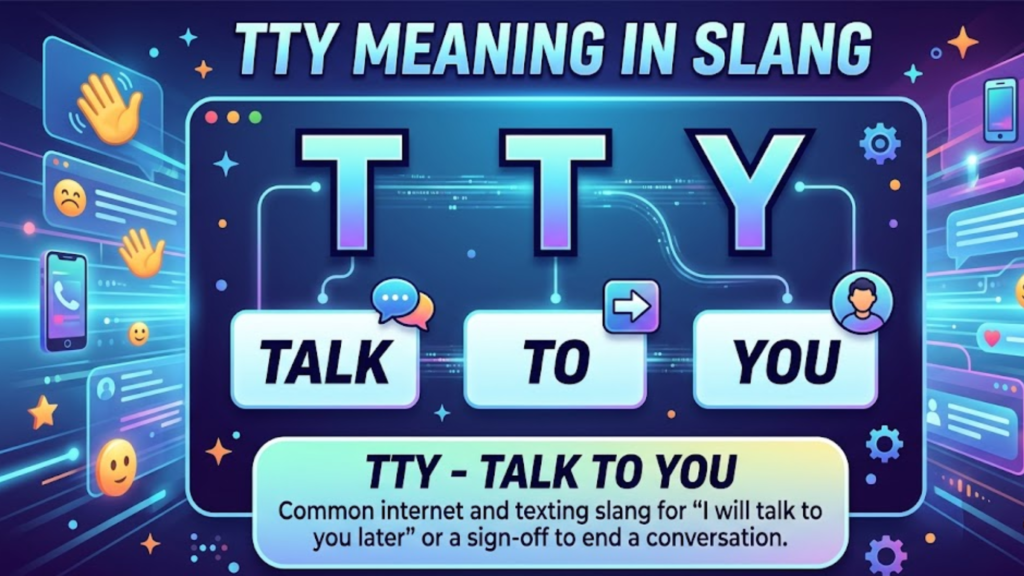
In internet slang and text messaging, TTY stands for “Talk To You.” It is used similarly to TTYS or TTYL, but without specifying “soon” or “later.” It is even more casual and abbreviated.
Slang examples:
- “Had fun! TTY 👋”
- “Gotta go, TTY when I’m back online”
- “TTY this weekend!”
TTY in slang is less common than TTYS or TTYL, but it appears frequently in very casual conversations among people who are comfortable with heavy text abbreviation.
TTY Meaning in Linux
Beyond texting, TTY has a completely different and significant meaning in computing — particularly in Linux and Unix-based systems.
In Linux, TTY stands for TeleTYpewriter. This traces back to the earliest days of computing, when physical teletypewriter machines were used to communicate with computers via keyboard and printed output.
Today in Linux, a TTY refers to a virtual terminal interface — a text-based environment used to interact with the operating system. When you open a terminal on a Linux machine, you are working within a TTY session.
Key points about TTY in Linux:
| Aspect | Detail |
|---|---|
| Full form | TeleTYpewriter |
| First release (tty command) | November 3, 1971 (Unix) |
| Modern meaning | Virtual terminal / command-line interface |
| Operating systems | Unix, Linux, macOS (terminal) |
| Related term | PTY (PseudoTeleTYpe) — a software-emulated terminal |
| Common command | tty — prints the file name of the terminal connected to standard input |
How TTY is used in Linux:
- Switch between virtual consoles using Ctrl + Alt + F1 through F6
- Each console is a separate TTY session
- Used by system administrators for low-level server management
- Helpful when the graphical interface crashes
Example in practice:
$ tty
/dev/pts/0
This output tells you which TTY session you are currently in.
TTY vs PTY:
- TTY (TeleTYpewriter): A real or virtual terminal handled directly by the operating system kernel
- PTY (PseudoTeleTYpe): A software-emulated terminal, used by terminal emulators like GNOME Terminal, iTerm2, or Windows Terminal
TTY also has a separate, important meaning in accessibility: a Telecommunications Device for the Deaf (TDD), sometimes also called a TTY machine, allows people with hearing or speech impairments to communicate over phone lines using typed text.
FAQs
Q: What does TTYS mean in a text? TTYS means “Talk To You Soon” — a friendly way to end a conversation while signalling you will be in touch again shortly.
Q: Is TTYS the same as TTYL? No. TTYS implies a sooner follow-up (“soon”), while TTYL is more open-ended (“later”). TTYS is slightly warmer and more immediate.
Q: Can I use TTYS at work? Only in very casual, informal workplace chats. Avoid it in emails, formal documents, or messages to senior colleagues.
Q: What does it mean when a girl sends TTYS? It means she enjoyed the conversation and plans to continue it. It is a warm, positive sign in any context.
Q: Is TTYS appropriate for dating apps? Yes — TTYS is actually ideal on dating apps. It shows interest without being pushy and signals you plan to reconnect.
Q: What is TTY in Linux? In Linux, TTY stands for TeleTYpewriter and refers to a virtual terminal interface used to interact with the operating system via command line.
Q: How do you respond to TTYS? Simply reply with “Talk to you soon!” or “TTYS!” or a friendly emoji-led sign-off like “Sounds good! 😊”
Q: Does TTYS have any offensive meaning? No. TTYS has no offensive or adult connotations in standard usage.
Q: How old is the term TTYS? TTYS originated in the late 1990s to early 2000s with the rise of instant messaging platforms like AIM and MSN Messenger.
Q: Is TTYS still used in 2026? Yes. TTYS remains a common and recognised farewell across all major messaging platforms including WhatsApp, iMessage, Instagram, Discord, and Snapchat.
Conclusion
TTYS is one of the simplest, friendliest, and most enduring acronyms in digital communication. Whether you are wrapping up a late-night chat with a close friend, closing a conversation on a dating app, or signing off from a gaming session on Discord, TTYS does the job with warmth and efficiency.
It is not rude, not outdated, and certainly not confusing — once you know what it means. It is a small word with a big social function: keeping conversations open, relationships warm, and digital goodbyes gentle.
And now that you know exactly what TTYS means, how it differs from TTYL, when to use it (and when not to), and even what TTY means in Linux — you are fully equipped to navigate this corner of digital language with confidence.
Next time someone sends you TTYS, you will know exactly how to respond. And next time you step away from a chat, you have a warm, tried-and-tested sign-off ready to go.
TTYS! 👋
