


If you’ve ever opened a group chat and seen someone type “ISTG this is the funniest thing I’ve seen all week,” you’ve probably paused for half a second to decode it. You’re not the only one. ISTG is one of those abbreviations that shows up everywhere — texts, Instagram captions, Discord servers, dating app messages — yet almost nobody explains why it carries so much emotional weight in such a short string of letters.
This guide breaks down the ISTG meaning in text, where it came from, how its tone shifts depending on who’s typing it, and when you should probably leave it out of a message altogether. By the end, you’ll be able to read ISTG the way native texters do, without second-guessing the tone.
What Does “ISTG” Mean in Text?
ISTG stands for “I Swear To God.” At its core, it’s a short way of telling someone that what you’re about to say is true, serious, or deeply felt.
The phrase “I swear to God” has been used in everyday speech for generations as a verbal stamp of sincerity. Texting culture simply compressed it into four letters so it could fit into fast-paced digital conversations without slowing anyone down.
What makes ISTG interesting is that it rarely functions as a literal oath anymore. Most people typing it aren’t making a religious statement at all — they’re using it as an emotional amplifier. It tells the reader: pay attention, I mean this.
You’ll usually see it in lowercase, often without punctuation, dropped casually into the middle or end of a sentence:
- “istg I almost cried laughing”
- “ISTG if this Wi-Fi cuts out one more time”
- “I’m not even joking, istg”
The exact emotional flavor depends entirely on context, which is why the same four letters can sound funny in one text and tense in another.
Why ISTG Took Off in Texting Culture
Long-form phrases don’t survive well in fast-paced digital conversations. As character limits, typing speed, and constant back-and-forth messaging became the norm, people naturally compressed common expressions into acronyms. ISTG became one of the more durable examples because it does something useful: it adds emotional weight without adding length.
A handful of factors helped it spread:
- Speed. Four letters type faster than four words, which matters in real-time chats.
- Universality. The underlying phrase already existed in everyday speech, so there was no learning curve.
- Flexibility. It works in serious, funny, frustrated, and flirty contexts without needing to be rewritten each time.
- Platform spread. Texting, Instagram, Snapchat, TikTok comments, and gaming chats all reinforced the same usage, which helped it stick across different online spaces rather than fading out in just one.
The Most Common Meanings of “ISTG”
While the literal translation never changes, the intent behind ISTG shifts depending on tone, punctuation, and the relationship between the people texting. Here are the four meanings you’ll run into most often.
1. Serious Honesty
This is the closest use to the original phrase. Someone uses ISTG to confirm that they’re telling the truth, especially when they expect to be doubted.
Example: “istg I sent the email, check your spam folder.”
Here, ISTG functions almost like a verbal handshake — a quick way of saying “trust me on this one.”
2. Frustration
ISTG often shows up right before or after a complaint, working as a pressure valve for annoyance.
Example: “ISTG if my package gets delayed again I’m losing it.”
In this case, it’s less about honesty and more about venting. The phrase signals “I’m at my limit,” without anyone needing to spell out the whole rant.
3. Emotional Emphasis
Sometimes ISTG isn’t about truth or frustration at all — it’s just there to make a feeling hit harder.
Example: “that sunset was unreal istg”
Nobody doubts that the sunset existed. The phrase is purely decorative here, adding intensity the way an exclamation point would.
4. Playful Exaggeration
Among friends, ISTG often gets used sarcastically or jokingly, especially when the statement itself is obviously not meant to be taken at face value.
Example: “istg I will fight a goose for you”
This use leans into humor. The dramatic phrasing is the joke, and ISTG just dials up the exaggeration.

How “ISTG” Is Used in Real Conversations
Context shapes meaning more than the abbreviation itself does. The same four letters read completely differently depending on where the conversation is happening, who’s involved, and what came right before it in the thread.
It helps to think of ISTG less as a fixed phrase and more as a tone marker — similar to how someone might raise their eyebrows or lean forward while speaking. It doesn’t change the facts of what’s being said; it changes how strongly the reader is meant to feel them.
Also Read This: WSP Meaning in Text: The Ultimate 2026 Guide to What It Really Means in Chats, DMs & Social Media
Friends & Casual Texting
Between close friends, ISTG is mostly filler for emotional emphasis. It’s low-stakes and shows up constantly in everyday back-and-forth texting, often paired with humor or exaggeration. You’ll see it dropped into stories about the day, reactions to memes, or quick venting sessions about something minor. In this setting, almost nobody pauses to question whether the speaker is being literal — the shared history between friends does the heavy lifting.
Instagram & Snapchat
On social platforms, ISTG frequently appears in captions, comments, and story replies to react to something funny, relatable, or dramatic. It works almost like a stand-in for “literally” or “no cap.” Because Instagram and Snapchat conversations move fast and lean heavily on shorthand, ISTG fits right into the rhythm of quick reactions — a single comment like “istg this is me” can carry an entire paragraph’s worth of relatable energy.
Dating Apps
In dating conversations, ISTG often softens a bold or flirty statement, making it feel more genuine and less like a rehearsed line.
Example: “istg you have the best laugh I’ve heard in a while”
It signals sincerity in a setting where people are naturally a little guarded.
Gaming & Online Communities
In gaming chats and Discord servers, ISTG usually pairs with frustration or hype, especially during competitive moments. It’s part warning, part inside joke, and almost always understood as harmless among regular teammates. You’ll often see it stacked with other gaming shorthand — “ISTG if you camp that spot one more time gg” — where the slang compounds to express frustration without slowing down the pace of the match.
Example: “ISTG if you camp that spot one more time”
Work or Professional Chat
ISTG rarely belongs in professional messaging. It can read as too casual or even unprofessional in a Slack channel or work email, which is something to keep in mind before using it outside personal conversations.
Is “ISTG” Rude, Flirty, or Offensive?
This is where a lot of confusion happens, especially across different age groups or cultural backgrounds. ISTG isn’t inherently positive or negative — its tone bends based on the situation.
| Context | Likely Tone | Example |
|---|---|---|
| Joking with friends | Harmless, funny | “istg you’re so dramatic 😂” |
| Heated argument | Can feel rude or intense | “ISTG just stop talking” |
| Dating conversation | Often flirty or sincere | “istg I can’t stop thinking about that” |
| Religious or formal context | Can feel inappropriate | “ISTG this meeting needs to end” |
When It Feels Harmless
In casual, friendly exchanges, ISTG almost always reads as lighthearted. Nobody assumes a literal oath is being made.
When It Feels Rude
During an argument or a tense exchange, ISTG can come across as aggressive, especially in all caps. “ISTG STOP” hits very differently than “istg stop lol.”
When It Feels Flirty
Paired with a compliment or an emotional admission, ISTG can soften a vulnerable statement and make it feel more authentic rather than scripted.
When It Feels Offensive
For some religious individuals, invoking “God” casually — even in abbreviated form — can feel disrespectful. This is worth remembering before sending ISTG to someone you don’t know well.
How to Respond When Someone Says “ISTG”
Replying to ISTG depends on what triggered it. Here are a few directions you can take.
Casual Replies
- “lol okay I believe you”
- “no way, fr?”
- “haha same honestly”
Funny Replies
- “ISTG energy detected 🚨”
- “the conviction in this text 😭”
- “say less, I’m with you”
Neutral Replies
- “got it, thanks for confirming”
- “okay that makes sense”
- “I hear you”
Professional Replies
If ISTG shows up in a more formal exchange, it’s best to respond in a neutral, non-slang tone:
- “Understood, thanks for letting me know.”
- “Noted — appreciate the update.”
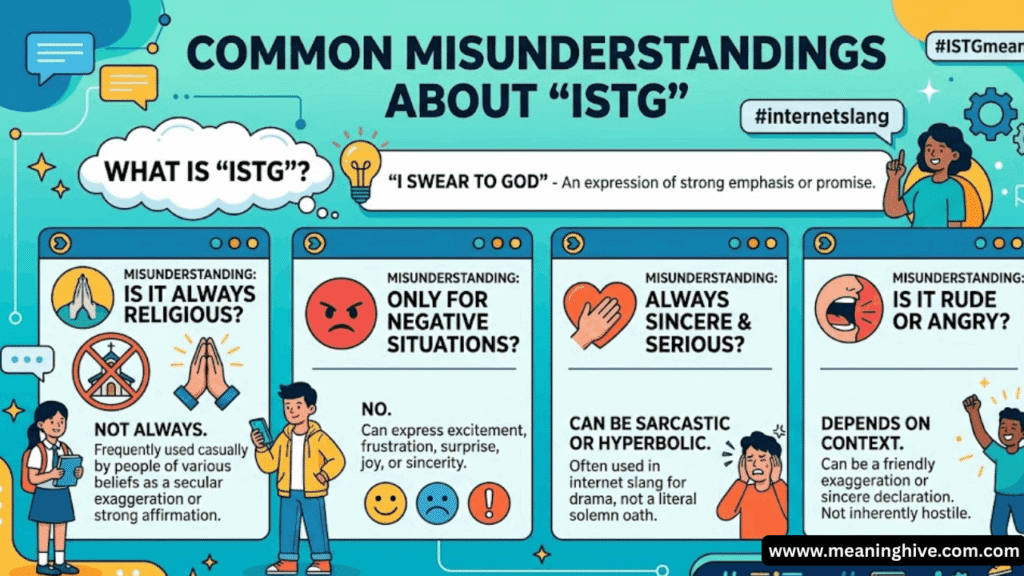
Common Misunderstandings About “ISTG”
A surprising number of mix-ups happen around this small phrase, especially between generations or across different texting styles.
Thinking It Always Means Anger
ISTG is just as likely to express excitement, humor, or sincerity as it is frustration. Reading it as automatically negative misses most of its actual use.
Thinking It Is Always Serious
Because the literal phrase is “I swear to God,” some readers assume every use is a heavy, formal declaration. In practice, it’s often the opposite — light and exaggerated.
Confusing It With Threats
In a heated context, ISTG can sound like a warning (“ISTG if you do that again”), but it’s rarely an actual threat. It’s closer to an expression of exasperation than a real ultimatum.
Missing Tone in Text
Without facial expression or vocal tone, ISTG can be misread easily. A joking “istg” can look serious to someone unfamiliar with how the sender normally texts, which is why context and relationship history matter so much.
Similar Slang Terms You Should Know
ISTG belongs to a broader family of emphasis-driven texting slang. Knowing these related terms makes it easier to read modern conversations accurately.
| Term | Meaning | Typical Use |
|---|---|---|
| FR | For Real | Confirming honesty or agreement |
| NO CAP | No lie / seriously | Emphasizing truthfulness |
| ONG | On God | Near-identical to ISTG |
| SMH | Shaking My Head | Expressing disappointment |
| DEADASS | Seriously / for real | East Coast slang for sincerity |
| TBH | To Be Honest | Prefacing a sincere or blunt opinion |
Most of these terms exist for the same basic reason ISTG does: text lacks tone of voice, so people layer in extra words to make sure a feeling actually lands.
When You Should Avoid Using “ISTG”
While ISTG is harmless in most everyday texting, a few settings call for more caution.
Professional Settings
Work emails, client messages, and formal Slack channels are not the place for ISTG. It can come across as unpolished or overly casual, even if that’s not the intent.
Cross-Cultural Chats
Not everyone shares the same texting slang vocabulary. In conversations with people from different countries or age groups, ISTG might cause confusion rather than clarity.
Religious Conversations
Because the phrase technically invokes a religious oath, using it casually around people discussing faith seriously can feel out of place or even disrespectful.
Sensitive Situations
During emotionally heavy conversations — grief, conflict, serious news — slang like ISTG can feel dismissive, even when that’s not the intention behind it.
A Quick Note on Look-Alike Terms: ISTJ, Not ISTG
If your search led you here while also looking into Bridgerton characters or Myers-Briggs personality types, it’s worth clarifying something important: that’s a different term entirely. “ISTJ” is a Myers-Briggs personality type (Introverted, Sensing, Thinking, Judging), often nicknamed “the Logistician.” It has nothing to do with the texting abbreviation ISTG.
The two get mixed up in search results because they’re only one letter apart, but they belong to completely different worlds — one is internet slang for emphasis, the other is a personality framework used in psychology and career assessments. If you were actually searching for personality type breakdowns or which Bridgerton character matches a specific MBTI type, that’s a separate topic worth searching on its own terms.
Conclusion
ISTG is a small abbreviation that carries a surprisingly wide emotional range. Depending on tone, punctuation, and context, it can express honesty, frustration, sincerity, or humor — sometimes all within the same conversation. Once you understand that ISTG is more about emotional emphasis than literal oath-taking, texts that once felt confusing start making a lot more sense.
The safest approach is simple: use ISTG freely with friends and casual contacts, read the room before using it in flirty or tense conversations, and skip it entirely in professional or formal settings. Slang like this moves fast, but the underlying skill — reading tone in text — never really goes out of style.
FAQs
What does ISTG mean in texting? ISTG stands for “I Swear To God,” used to emphasize honesty, frustration, or strong emotion in a message.
Is ISTG rude? Not inherently — it’s harmless in casual chats but can feel intense or inappropriate in arguments or formal settings.
Is ISTG the same as ISTJ? No. ISTG is texting slang for “I Swear To God,” while ISTJ is a Myers-Briggs personality type.
Can ISTG be flirty? Yes, when paired with a compliment or sincere statement, ISTG often softens flirty messages and makes them feel genuine.
Should I use ISTG at work? It’s best avoided in professional messages, since it can come across as too casual for formal communication.
What’s a similar slang term to ISTG? “ONG” (On God) and “FR” (For Real) are close equivalents, both used to emphasize sincerity in a message.
