

You’re in the middle of a group chat, and someone drops a link with just two words before it — “NSFW 🔞.” You pause. Should you open it? Is it a joke? Is it something explicit? If you’ve ever had that split-second confusion, you’re not alone. Millions of people search for NSFW meaning in text every month, and for good reason — this acronym pops up everywhere from WhatsApp to Reddit, from TikTok comments to workplace emails.
This guide breaks down exactly what NSFW means, where it came from, how it’s used across platforms and cultures, and when you should (and shouldn’t) use it yourself.
NSFW Meaning in Text (Direct Answer)
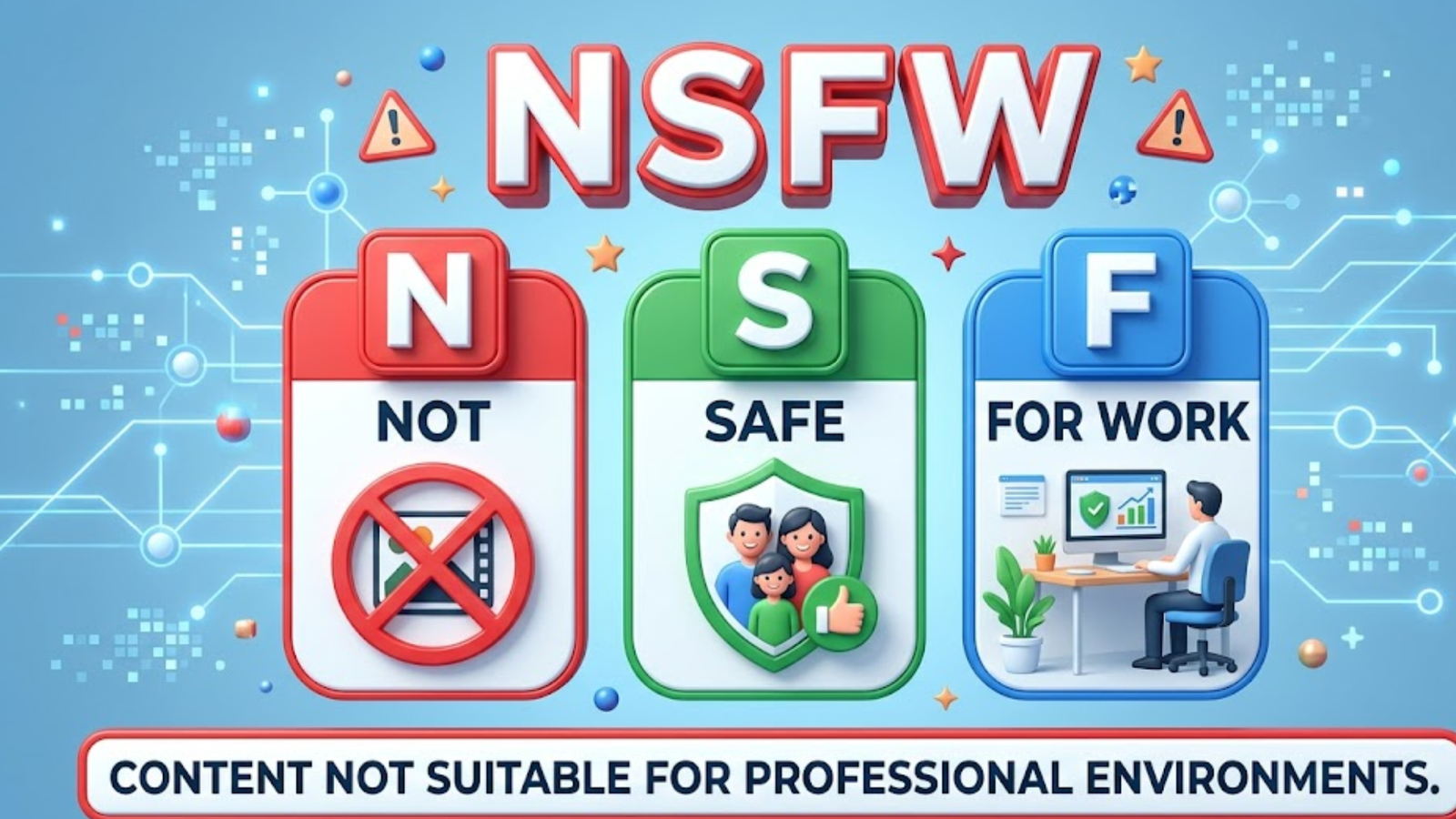
NSFW stands for “Not Safe For Work.”
It’s a warning label placed before a link, image, video, or message to let the viewer know the content may be inappropriate, explicit, or sensitive — something you shouldn’t open on a work computer, in a classroom, or in any public setting where others might see your screen.
| Acronym | Full Form | Category |
|---|---|---|
| NSFW | Not Safe For Work | Internet Slang / Content Warning |
| SFW | Safe For Work | Opposite of NSFW |
| NSFL | Not Safe For Life | Extreme/disturbing content |
Meaning & Definition
Primary Meaning
The primary meaning of NSFW is a content warning. It signals that whatever follows contains material that is sexually explicit, graphically violent, deeply offensive, or otherwise inappropriate for professional or public viewing. Think of it as a digital version of the “Viewer Discretion Advised” warning you see before certain TV programs.
Secondary Meaning
Over time, NSFW has developed a secondary, more casual meaning in Gen Z culture. People now sometimes use it humorously — tagging something as “NSFW” even if it’s just mildly embarrassing, edgy, or funny in a crude way. In meme culture, it has become a tool to generate curiosity and clicks as much as a genuine safety warning.
Chat Examples
Here’s how NSFW looks in real conversations:
Example 1 — Genuine Warning:
Zara: Hey, sending you a link but it’s NSFW, open it when you’re alone. Ali: Got it, will check it at home.
Example 2 — Humorous Use:
Kamran: Bro this meme is NSFW 😂 Hassan: Lol it’s just a weird cake, relax.
Example 3 — Social Media Caption:
“NSFW: This comedy sketch contains strong language. Watch with headphones.”
Background & Origin
The story of NSFW starts earlier than most people think. According to academic research, the term “NSFW” was first proposed as early as 1998, making it one of the oldest acronyms born out of internet culture. However, it gained widespread momentum in the early 2000s as workplaces became more digitally connected and employees started sharing links via email and early online forums.
The problem was obvious: someone would forward a funny link to a colleague, who would click it during a meeting — only to have explicit content fill the screen. NSFW emerged as a quick, universally understood fix. Early platforms like Snopes forums, 4chan, and eventually Reddit helped cement the tag as standard internet etiquette.
Reddit, in particular, made NSFW into an official system-level tag. The platform requires users to mark posts containing nudity, strong language, or graphic imagery as NSFW so that the platform can blur or restrict the content by default. This formal institutionalization is a big reason the term went from forum slang to global digital vocabulary.
Usage in Different Contexts
Casual Chats
In WhatsApp, iMessage, and DMs, NSFW works as a quick heads-up between friends. It’s informal, often accompanied by a winking or laughing emoji, and usually means the content is either genuinely explicit or just too funny/weird to open at the dinner table.
Social Media
On Instagram, TikTok, and X (formerly Twitter), NSFW appears in captions, comments, and content warnings. Some creators use it to drive engagement — the curiosity factor of “NSFW” in a caption pushes people to click. Platforms themselves have begun auto-blurring content flagged as sensitive, using the same logic as NSFW tagging.
Professional Use
NSFW occasionally appears in workplace emails, usually when a colleague is forwarding a piece of content that’s humorous but slightly off-color. It signals self-awareness — the sender acknowledges the content isn’t exactly “office-appropriate” but is sharing it anyway in a trusted context.
Gaming / Group Chats
In Discord servers and gaming communities, NSFW channels are designated spaces where adult humor, memes, or mature content is allowed. Many Discord servers require age verification before granting access to NSFW channels.
Meanings Across Platforms
| Platform | How NSFW Is Used |
|---|---|
| Official post/community tag; hides content behind a blur | |
| Discord | Dedicated NSFW channels requiring age verification |
| Caption warning; platform may restrict reach | |
| TikTok | Rare, used in descriptions for edgy or mature humor |
| Informal warning in personal or group chats | |
| Snapchat | Story or snap warning before private/explicit content |
| X (Twitter) | Content label on posts; media blurred until clicked |
| Occasional workplace use as a courtesy warning |
Real-Life Examples & Memes
NSFW has become deeply embedded in meme culture. Entire subreddits, Discord communities, and meme pages are built around NSFW content. Some common real-life scenarios include:
- A friend texting “NSFW but this video is hilarious” before a link that contains crude humor
- A Reddit post tagged NSFW showing a graphic weight-loss photo or a medical image — not sexual, but still sensitive
- A Twitter thread marked NSFW because it discusses adult mental health topics in clinical detail
- Meme accounts on Instagram using “NSFW 😈” in captions to boost curiosity and engagement
The term has also been parodied. Sometimes people tag completely harmless content as NSFW as a joke — you click, expecting something wild, and it’s just a cat falling off a chair.
Cultural or Regional Interpretations
US / UK
In the United States and United Kingdom, NSFW is well-established internet vocabulary. It’s understood across age groups, though younger users (Gen Z, Millennials) tend to use it far more frequently and creatively. In the UK, it sometimes carries a drier, more ironic tone.
Asia (India, Pakistan, Philippines)
NSFW is widely understood in urban digital communities across South and Southeast Asia. In Pakistan and India, where English-language internet culture is prevalent especially among younger generations, NSFW is used in the same way as in Western countries — primarily as a content warning in WhatsApp groups and social media. It carries a slightly more cautious cultural weight given stricter social norms around explicit content.
Australia
Usage in Australia mirrors the US/UK pattern — casual, widely recognized, and often used humorously. Australians tend to apply it loosely, sometimes tagging content NSFW that’s just a bit irreverent rather than genuinely explicit.
Other Meanings
While “Not Safe For Work” is the overwhelmingly dominant meaning, NSFW occasionally gets used in other contexts:
| Alternative Meaning | Context |
|---|---|
| Not Suitable For Work | Variant phrasing, same meaning |
| Not Safe For Wives/Women | Old internet joke, rarely used today |
| Not Safe For Web | Outdated early usage |
| Nice Story, Forget Work | Humorous backronym, not widely used |
None of these alternatives are in mainstream use. If you see NSFW in any standard digital conversation, it means Not Safe For Work.
Also Read This: RS Meaning in Text: Shocking Truth You Need to Know in 2026
Common Mistakes & Misconceptions
A few misunderstandings surround NSFW that are worth clearing up:
- Misconception: NSFW only means sexual content. Reality: It covers graphic violence, disturbing imagery, extreme profanity, and anything embarrassing to view publicly.
- Misconception: NSFW content is always illegal. Reality: Most NSFW content is legal adult material. The tag is about context appropriateness, not legality.
- Misconception: Tagging something NSFW means you have permission to share it anywhere. Reality: NSFW is a warning, not a permission slip. Always consider your audience and platform rules.
- Misconception: If you’re working from home, NSFW warnings don’t apply. Reality: NSFW content can still cause problems — depending on your company’s IT policies and monitoring.
Psychological / Emotional Meaning
There’s an interesting psychological dimension to the NSFW tag. It works partly because of the curiosity effect — when something is labeled as forbidden or sensitive, human attention instinctively gravitates toward it. Content marked NSFW often gets more clicks, not fewer.
From the sender’s side, using NSFW signals digital empathy — an awareness that not everyone shares the same comfort level with explicit content. It gives the recipient a moment of informed choice. This small act of consideration is more significant than it seems in an age of accidental content exposure.
Similar Terms & Alternatives
| Term | Meaning | Usage |
|---|---|---|
| SFW | Safe For Work | Opposite of NSFW; content is fine to view publicly |
| NSFL | Not Safe For Life | Extreme, disturbing content (gore, trauma) |
| TW / CW | Trigger Warning / Content Warning | Used for emotionally sensitive topics |
| 18+ | Age-restricted content | Legal age label on adult platforms |
| Explicit | Directly sexual or graphic | Common on streaming platforms like Spotify |
Is It Offensive or Friendly?
NSFW itself is not an offensive term. It is a neutral, utilitarian label — a courtesy flag rather than an insult. Using it correctly is actually considered polite digital etiquette.
However, context shapes perception:
- In a professional email, dropping NSFW can feel awkward depending on the workplace culture.
- In friend groups, it’s casual and often used with humor.
- Misusing it — tagging content NSFW that isn’t, or failing to tag content that genuinely is — can frustrate or mislead people.
The bottom line: NSFW is a tool for consideration, not a weapon or an insult.
Grammar or Linguistic Insight
NSFW is an initialism (not a true acronym), because each letter is spoken individually: “N-S-F-W.” A true acronym is pronounced as a word (like NASA or SCUBA).
It functions grammatically as both an adjective and a noun:
- Adjective: “This video is NSFW.”
- Noun: “Put an NSFW tag on it.”
It can also appear in lowercase (nsfw), especially in informal contexts like Reddit post titles or casual texts.
How to Respond
Received something labeled NSFW and not sure how to reply? Here are natural responses depending on tone:
| Situation | Response Option |
|---|---|
| Casual/funny content | “😂 warned me just in time!” |
| Genuinely explicit | “Thanks for the heads-up, I’ll check later.” |
| Didn’t want to receive it | “Please don’t send NSFW stuff to this chat.” |
| Curious | “Is it actually NSFW or are you just hyping it?” |
| Professional setting | “Let’s keep this thread SFW, please.” |
Differences From Similar Words
NSFW vs. NSFL: NSFW is a general warning covering explicit but typically adult-legal content. NSFL (Not Safe For Life) signals content that is severely disturbing — gore, real violence, graphic trauma. NSFL is the stronger, rarer tag.
NSFW vs. TW (Trigger Warning): NSFW focuses on setting appropriateness (work, school, public). A Trigger Warning focuses on emotional safety — flagging content that may cause psychological distress regardless of location.
NSFW vs. Explicit: “Explicit” is typically a platform label (Spotify, Apple, app stores) for sexual or profane content in music or media. NSFW is a user-generated conversational warning.
Relevance in Dating & Online Culture
On apps like Tinder, Bumble, and Snapchat, NSFW has taken on a distinctly flirtatious dimension. Sending “NSFW 😈” in a DM is often used as a teasing opener before sharing a suggestive photo or message. It signals intent while technically giving the recipient a choice.
In broader dating culture, NSFW content has become normalized as part of digital intimacy — but always with an important caveat: consent matters. Sending unsolicited NSFW content is considered a violation of digital etiquette and, in many places, is legally actionable. The tag does not replace consent — it merely precedes a request for it.
Popularity & Trends
NSFW has shown consistent search interest for over a decade and shows no signs of fading. Several trends keep it relevant:
- The rise of AI-generated content has flooded platforms with explicit material, making content warning practices more important than ever.
- Work-from-home culture blurred the line between professional and personal browsing, making the “work” context feel more complicated but the warning more necessary.
- Platform enforcement — Reddit, Discord, and X have all built NSFW tagging into their moderation infrastructure, giving the term institutional staying power.
- Meme culture continues to recycle NSFW as a comedic device, keeping it in daily digital vocabulary.
When NOT to Use NSFW
Knowing when not to use NSFW is just as important as knowing when to use it:
- Don’t use it ironically in professional emails — even as a joke, it can come across as unprofessional or inappropriate.
- Don’t use it as a blanket excuse to send explicit content without checking if the recipient consents.
- Don’t overuse it on content that isn’t actually sensitive — it dilutes the warning’s effectiveness.
- Don’t use it in contexts where minors are present, such as school group chats or family message threads.
- Don’t use it to get around platform rules — tagging something NSFW doesn’t mean you can post it on SFW-only platforms.
NSFW Meaning on Reddit
Reddit is arguably the platform most closely associated with the NSFW tag at an institutional level. The platform’s official policy requires that any content containing nudity, pornography, or profanity that a reasonable viewer wouldn’t want to be seen accessing in a public or formal setting must be tagged NSFW.
On Reddit, NSFW applies to:
- Individual posts — blurred thumbnail until the user actively clicks to reveal
- Entire subreddits — communities marked 18+ or “Mature,” requiring users to confirm their age before browsing
- User profiles — accounts that primarily share adult content can be marked NSFW
The NSFW tag on Reddit is also said to have originated from the Snopes forum, when a child accidentally viewed inappropriate content — prompting the community to adopt a standardized warning system.
NSFW Meaning in Adult Content
In the context of adult content platforms — including OnlyFans, certain subreddits, and private Discord communities — NSFW has become shorthand for 18+ sexual content. Here, it moves beyond a warning and functions more like a category label.
This is an important distinction. Elsewhere, NSFW is context-dependent — something might be NSFW at work but perfectly acceptable at home. In adult content ecosystems, NSFW is a definitive category marker indicating the content is sexually explicit by design.
NSFW Stands For — Slang Breakdown
At its core, NSFW is slang that evolved into mainstream digital language. Here’s the quick breakdown:
- N — Not
- S — Safe
- F — For
- W — Work
Simple, but effective. Its longevity comes from how universally the problem it solves — “don’t open this where people can see your screen” — applies to everyone with an internet connection.
What Does NSFW Mean — Inappropriate Content Defined
Not all inappropriate content is the same. When someone labels something NSFW, they could mean any of the following:
- Sexual or explicit imagery — nudity, pornographic content
- Graphic violence — injuries, war footage, disturbing accidents
- Strong or offensive language — extreme profanity or slurs
- Controversial or taboo topics — content that could offend based on political, religious, or social views
- Embarrassing or cringe-worthy content — things you simply wouldn’t want a boss or parent to see
The common thread is social context: NSFW content isn’t necessarily wrong or illegal — it’s just poorly suited for certain audiences or settings.
Conclusion
NSFW is one of the internet’s most durable pieces of slang for a simple reason — it solves a real problem. In a world where we’re constantly toggling between work emails and personal group chats, between professional calls and late-night Reddit scrolling, having a quick, universally understood content warning matters.
Whether it’s used as a genuine safety flag before sharing explicit content, or deployed with a winking emoji in a friend’s DM, NSFW has earned its place in modern digital vocabulary. The key is knowing what it means, respecting what it signals, and using it with the consideration it was designed to promote.
FAQs
What does NSFW mean in a text message? It stands for “Not Safe For Work” — a warning that the content may be inappropriate or explicit.
Is NSFW only for sexual content? No. It also covers graphic violence, strong language, and anything embarrassing to view in public or at work.
Where did NSFW come from? It originated in early internet forums around 1998–2000 and became mainstream through Reddit and email culture.
Is it offensive to call something NSFW? No. NSFW is a neutral content label. Using it correctly is considered considerate online behavior.
What is the opposite of NSFW? SFW — “Safe For Work” — meaning the content is appropriate to view in any setting.
What does NSFW mean on Reddit? On Reddit, NSFW is an official tag that blurs content and restricts it to users who have opted into viewing mature material.
Can I use NSFW in a work email? It’s best to avoid it unless you know your workplace culture well. Even as a joke, it can come across as unprofessional.
What is the difference between NSFW and NSFL? NSFW warns about explicit or inappropriate content. NSFL (Not Safe For Life) warns about severely disturbing content like graphic violence or gore.
Does NSFW always mean adult content? Not always. It means any content not suitable for professional or public settings — which can include violence, offensive language, or anything cringe-worthy.
Should I reply to an NSFW message? It depends on context. A simple “Got it, will check later” or a laugh emoji works fine. If you didn’t want to receive it, it’s okay to say so clearly.
