

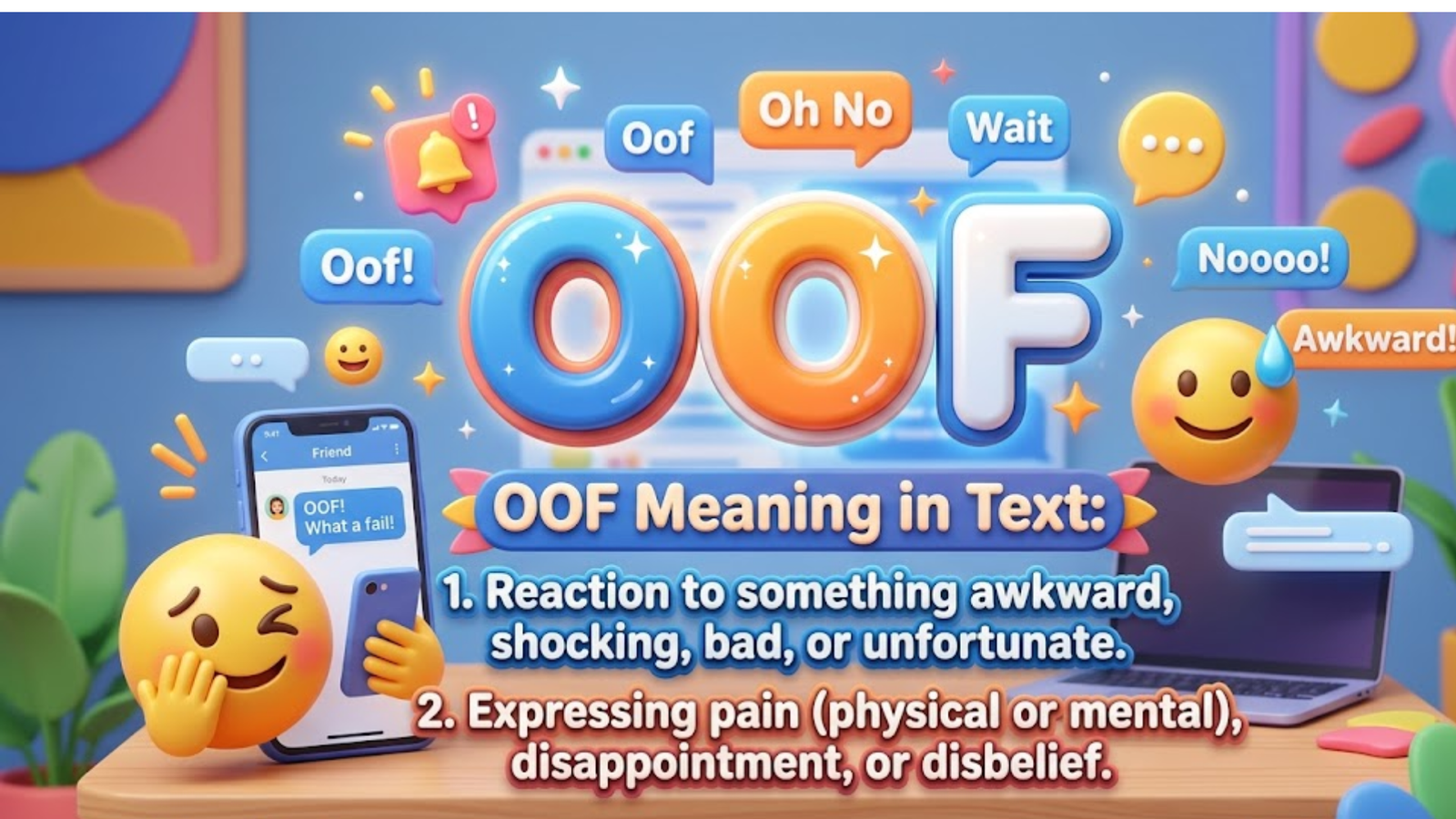
You are scrolling through your messages and someone replies with a simple “oof.” What does that even mean? Is it sarcasm? Sympathy? A typo? If you have ever been confused by this tiny word, you are not alone. Millions of people search for the OOF meaning in text every month because it shows up everywhere — in group chats, Instagram comments, TikTok replies, Discord servers, and even dating apps.
The truth is, “oof” is one of the most flexible slang terms in digital communication today. It can express pain, awkwardness, sympathy, shock, or humor — all in three letters. This guide breaks down everything you need to know: its definition, origin, how it is used across platforms, what it means when a guy sends it, and whether it belongs in professional settings.
Let’s get into it.
Definition & Meaning
OOF is an informal slang exclamation used to express a reaction — usually to something uncomfortable, awkward, painful, surprising, or unfortunate. Think of it as a written version of a groan, wince, or sigh.
At its core, “oof” communicates emotion quickly without needing a full sentence. It is situational, meaning its exact tone depends on the context of the conversation.
What Does OOF Stand For?
In casual texting and online use, “oof” is not technically an acronym — it is an onomatopoeia, meaning it mimics a sound. It copies the involuntary noise a person makes when they get hit, see something cringe-worthy, or feel second-hand embarrassment.
However, “OOF” does have an alternative acronym meaning in professional settings:
| Context | OOF Meaning |
|---|---|
| Casual texting / social media | Reaction to pain, awkwardness, or sympathy |
| Workplace / corporate tools | Out of Office (common in Outlook, Microsoft Teams) |
| Legal circles | Order of Forfeiture |
| British historical slang | Money or cash (used in 19th century) |
The most common meaning — and what almost everyone means when they type it in a chat — is the emotional reaction version.
Quick OOF Definition
OOF (interjection): A short, expressive reaction used in texting and online communication to show sympathy, discomfort, secondhand embarrassment, mild shock, or acknowledgment of something unfortunate.
Background & History
Where Did OOF Come From?
The word “oof” has a surprisingly long history. Here is how it evolved from an old sound effect into a viral internet term:
Early use in print and comics: Words like “oof,” “bam,” and “pow” appeared in old comic books as visual representations of impact sounds. They were used to depict characters getting hit or falling.
19th century British slang: Historically, “oof” was used in British informal language as slang for money. It appeared during the 1892 Osborne trial and likely had been in use for decades prior.
Gaming culture and Roblox: The biggest turning point came from the massively popular online game Roblox. The game featured a distinctive “oof” sound effect that played whenever a character died or was injured. Players loved it. The sound became iconic — and it did not stay inside the game.
Meme explosion (early 2010s to late 2010s): Once Roblox players started sharing clips and screenshots online, the “oof” sound became a running joke and then a full-blown meme. Reddit, Twitter, and YouTube helped spread it rapidly. By the late 2010s, “oof” had crossed over from gaming culture into mainstream texting.
2020s — mainstream slang: Today, “oof” is part of everyday digital vocabulary across generations, platforms, and countries. It is no longer exclusive to gamers or Gen Z. Millennials, parents, and even some workplaces have adopted it.
Also Read This: KYS Meaning in Text: What It Really Means, Uses, and How to Respond (2026)
Usage in Various Contexts
One of the reasons “oof” is so popular is that it fits almost any situation. Here is how it is used across different settings:
In Text Messages
Used to react quickly to something unfortunate or embarrassing. It saves time and keeps the tone light.
- Friend: “I walked into the wrong classroom in front of 30 people.”
- You: “Oof 😬”
On Social Media
“Oof” appears in comment sections under posts about fails, bad luck, or relatable struggles. It signals empathy or mild shock without typing a long response.
- Instagram caption: “Just got rejected from my dream job.”
- Top comment: “Oof. Their loss honestly.”
In Gaming Communities
This is where it all started. Players use “oof” to react to a teammate’s death, a bad move, or an embarrassing loss.
- “Oof, walked right into that ambush.”
- “The enemy team oof’d us in round one.”
In Memes
“Oof” frequently appears as a punchline or caption in reaction memes — especially under content that depicts failure, awkward situations, or things going wrong in unexpected ways.
Platform-by-Platform Breakdown
| Platform | Typical OOF Use |
|---|---|
| WhatsApp / iMessage | Sympathy or reaction to bad news |
| Comments on fails, relatable posts | |
| TikTok | Replies to cringe or emotional content |
| Twitter / X | Quick reactions to awkward news or drama |
| Discord | Gaming reactions and server humor |
| Snapchat | Casual reaction to stories or messages |
| Dating apps | Playful empathy or humor |
Common Misconceptions & Clarifications
A lot of people misread “oof” the first time they encounter it. Here are the most common myths:
Myth #1: OOF means anger. Not true. “Oof” is almost never a sign of anger. It is usually empathetic, sympathetic, or humorous.
Myth #2: OOF is offensive. It is not. “Oof” is a neutral, safe-for-most-audiences expression. It does not carry rude or hateful undertones.
Myth #3: OOF only means “Out of Office.” That is only true in corporate email tools like Outlook. In texting and social media, nobody uses “oof” to mean Out of Office.
Myth #4: OOF and “uff” mean the same thing. They are related but different. “Uff” (common in South Asian English and some European languages) tends to carry stronger frustration or exasperation. “Oof” is softer and more playful.
Myth #5: Only Gen Z uses “oof.” Not anymore. While Gen Z popularized it, the term has spread widely across age groups.
Similar Terms & Alternatives
If someone is not using “oof,” they might use one of these alternatives that carry similar meanings:
| Term | Meaning / Nuance |
|---|---|
| Ouch | More literal, usually physical pain |
| Yikes | More dramatic, expresses shock or alarm |
| Bruh | More humorous or disbelieving |
| Yikes | Stronger surprise, sometimes sarcastic |
| Welp | Acceptance of a bad situation |
| Ugh | Frustration, less empathetic |
| Aw man | Softer disappointment |
| That’s rough | More conversational sympathy |
“Oof” sits in a unique spot — it is softer than “yikes,” more expressive than “oh,” and funnier than “sorry.” That balance is why it became so popular.
How to Respond to This Term
Receiving “oof” in a message can feel ambiguous. Here is how to handle it based on context:
If someone says “oof” after your bad news:
They are showing sympathy. You can:
- Say “Yeah, it’s rough” and continue the conversation.
- Add more context if you want them to engage further.
- Use humor to lighten the mood.
If someone says “oof” in response to a joke:
They found it funny or cringe-worthy. Respond playfully.
If you want to reply to someone else’s “oof”:
- “Right? It was so embarrassing 😭”
- “Oof is the only word for it honestly.”
- “Tell me about it.”
What NOT to Do
Avoid overthinking it. “Oof” is casual. If someone sends it, they are engaging with you, not judging you.

Regional or Cultural Differences
United States & Canada
“Oof” is very common in everyday texting and social media. Gaming culture made it mainstream here first, and it is now used across age groups.
United Kingdom & Australia
Used frequently, though alternatives like “ouch” or “mate, that’s rough” may appear more in British English. “Oof” is still well understood.
South Asia (India, Pakistan, Bangladesh)
“Oof” is growing in popularity, especially among younger, English-speaking generations who are active on Instagram, TikTok, and gaming platforms. “Uff” or “uff yaar” is the regional equivalent, often used interchangeably.
East Asia (Japan, South Korea, China)
Less common in everyday use. Local internet slang tends to dominate. However, gamers and social media users in these regions are familiar with “oof” through Roblox and global meme culture.
Latin America
Adopted mostly through gaming and meme communities. Spanish equivalents like “ay” or “uff” often serve the same purpose in native conversations.
Global Corporate Use
In workplace tools like Microsoft Outlook, “OOF” universally means Out of Office, regardless of country or language.
Comparison with Similar Terms
| Term | Emotional Intensity | Tone | Best Used When |
|---|---|---|---|
| OOF | Mild to moderate | Empathetic, humorous | Reacting to awkward or unfortunate moments |
| OUCH | Moderate | Direct, literal | Physical or clear emotional pain |
| YIKES | High | Alarmed, dramatic | Something shocking or troubling |
| BRUH | Low to moderate | Humorous, disbelieving | Something absurd or funny |
| WELP | Mild | Resigned, casual | Accepting an unavoidable bad situation |
| UGH | Moderate | Frustrated | Irritation or repeated annoyance |
“Oof” wins for versatility. It works in more situations than almost any of its alternatives, which is the main reason it has stuck around and spread so widely.
Usage in Online Communities & Dating Apps
Online Communities
In Reddit threads, Discord servers, and gaming lobbies, “oof” functions like a universal reaction sticker. It is used to:
- React to someone sharing a failure or embarrassing story.
- Acknowledge a teammate’s mistake without being harsh.
- Respond to meme content that is particularly painful or relatable.
- Keep the tone light in otherwise tense conversations.
Because it is so short, it is ideal for fast-moving chat environments where long replies slow down the conversation.
On Dating Apps (Tinder, Bumble, Hinge)
“Oof” shows up in dating app conversations more than you might expect. Here is how it plays out:
Flirty use: “Oof, you’re way out of my league 😉” — used playfully to compliment someone.
Empathetic use: “Oof, sorry your last date ghosted you. That’s rough.” — used to connect over shared bad experiences.
Humorous use: “Oof, that first date story 😂” — used to react to a funny or cringe story, creating a bonding moment.
On dating apps, “oof” works well because it keeps the conversation casual and shows emotional awareness without being dramatic. It signals that you are engaged without overwhelming the other person.
Hidden or Offensive Meanings
Here is the straightforward answer: “oof” has no hidden offensive meaning in standard use.
It is not coded language for anything inappropriate. It does not carry racial, sexual, or political connotations. It is not used as an insult in standard online communication.
The only potential issue is tone. In rare cases, replying with just “oof” to someone sharing something genuinely serious could come across as dismissive. If a friend is dealing with real grief or a major crisis, a fuller response is always better than a single “oof.”
Outside of that, you can use “oof” freely without worrying about hidden meanings.

Suitability for Professional Communication
Short answer: use with caution.
“Oof” is casual slang. In most formal professional environments — formal emails, client reports, or official documents — it does not belong. However, the line is blurring in some modern workplaces.
When OOF Is Acceptable at Work
- Slack or Teams messages with close colleagues you have a casual relationship with.
- Internal chat reactions to light, non-critical workplace moments.
- Startup or creative agency cultures where casual tone is the norm.
When to Avoid It
- Client-facing emails or messages.
- Formal reports or presentations.
- Messages to senior management you do not know well.
- Any HR-related communication.
Professional Alternatives to “Oof”
Instead of “Oof, that’s a tough situation,” try:
- “That does sound like a challenge.”
- “I understand — that’s a difficult position to be in.”
- “I appreciate you flagging this.”
OOF Meaning in Text from a Guy
When a guy texts you “oof,” what is he actually communicating? Context matters a lot here, but here are the most common interpretations:
He Is Showing Sympathy
If you shared bad news or vented about something hard, his “oof” is saying: “That sucks. I hear you.” It is a low-effort but genuine form of empathy. Guys often use short reactions like this to show they are listening without overcomplicating the response.
He Finds It Funny (or Cringe-Worthy)
If you shared something embarrassing or told a story that is kind of absurd, his “oof” might come with a laugh emoji and means: “That’s hilarious. I felt that.”
He Is Being Casual and Comfortable
Using slang like “oof” signals he feels comfortable with you. It is informal, relaxed communication. If a guy texts “oof,” he is not being cold — he is being casual.
Reading the Tone
| If he sends… | He probably means… |
|---|---|
| “Oof 😬” | Sympathy with mild awkwardness |
| “OOOF 😂” | He finds it genuinely funny |
| “Oof, that’s rough” | He cares and wants to acknowledge your situation |
| Just “oof.” | Understated empathy, sometimes dry humor |
Emojis are the key to reading his intent. “Oof 😭” hits differently than “oof 😂.”
OOF Meaning on Social Media
On social media, “oof” functions as a reaction currency — quick, universally understood, and appropriate in almost any comment section. Here is the platform-by-platform breakdown:
“Oof” appears in comments under posts about failure, relatable life struggles, or awkward moments. It performs similarly to the “crying laughing” emoji — it signals recognition of shared human experience.
TikTok
In TikTok comments, “oof” is often used under videos showing fails, emotional moments, or cringe content. Creators sometimes use it in their own captions to pre-emptively acknowledge something uncomfortable about their content.
Twitter / X
Quick “oof” replies are extremely common under tweets about embarrassing situations, breaking news reactions, or celebrity drama. It has become a shorthand reaction in the same category as “lol” or “same.”
Reddit users drop “oof” in threads to react to r/tifu (Today I F***ed Up) posts, r/Wellthatsucks content, or any story where something clearly went wrong. It is an empathetic community signal.
OF Meaning in Text Message
One quick note since many people also search for this: “of” in a text message is not the same as “oof.” In most cases:
- “of” is simply the preposition used in a sentence, typed quickly.
- Some users type “of” as a typo or shorthand for “obviously” (similar to “obv”).
- It is sometimes a casual correction: “of course” shortened to “of course” or just “of.”
If someone replied “of” to your message, they likely mean “of course” — it is an informal agreement. It does not carry the same emotional meaning as “oof.”
Frequently Asked Questions (FAQs)
Q: What does OOF mean in texting? A: It is a slang reaction expressing sympathy, awkwardness, pain, or mild shock in response to something unfortunate or cringe-worthy.
Q: Is OOF positive or negative? A: Neither — it is neutral. It can be empathetic, humorous, or simply acknowledge that something went wrong.
Q: Where did OOF come from? A: It originated as a sound effect in the online game Roblox and spread through memes and gaming culture into mainstream texting.
Q: What does OOF mean from a guy? A: Usually sympathy or casual empathy — his way of saying “that sucks” or “I feel you” without overthinking the response.
Q: Is OOF offensive? A: No. It carries no offensive or hidden meaning in standard use.
Q: Can I use OOF at work? A: Only in very casual internal chats. Avoid it in formal or client-facing communication.
Q: What is the difference between OOF and Ouch? A: “Ouch” is more literal and direct; “oof” is softer, more versatile, and often carries a humorous undertone.
Q: What does OOF mean on social media? A: A quick reaction to awkward, painful, or relatable content — essentially a written wince or sigh.
Q: Does OOF mean Out of Office? A: Only in professional email tools like Microsoft Outlook. In casual texting, it means something completely different.
Q: What should I reply when someone texts me OOF? A: Depends on context — you can continue the conversation, add more detail, or use humor. There is no single correct reply.
Conclusion
“Oof” is one of those rare slang terms that managed to jump from a niche gaming sound effect to a universal expression used by millions of people every day. Whether someone sends it to show they feel your pain, react to something awkward, or lighten a tense moment, the OOF meaning in text is always rooted in the same idea: I acknowledge what just happened, and I’m reacting to it.
Understanding slang like this helps you communicate more naturally online, decode what people actually mean in a message, and avoid misreading casual tone as something more serious. “Oof” is not dramatic. It is not offensive. It is just a small, efficient word doing a lot of emotional work in digital conversation.
Now that you know exactly what it means and how to use it — go ahead and drop an “oof” next time someone shares something that deserves one.
