

You get a text that just says “OTW.” No context. No explanation. Just three letters sitting there in your inbox.
Is it urgent? Casual? Flirty? A little rude, even?
If you’ve paused over a message like this, you’re not overthinking it as much as you might think. “OTW” is one of the most-used texting abbreviations on the planet, yet it’s also one of the most misread. The same three letters can mean “I’m racing to get to you” in one chat and “eventually, don’t wait up” in another.
Part of the confusion comes from how widely OTW travels across platforms. The same abbreviation shows up in a text from your roommate, a comment under an Instagram reel, a gaming party chat, and a casual Slack message from a coworker — and it doesn’t always carry the same weight in each place.
This guide breaks down exactly what OTW means, how it shifts across friendships, dating, gaming, and work chats, and how to reply without sounding awkward. By the end, you’ll never have to guess again.
What Does “OTW” Mean in Text?
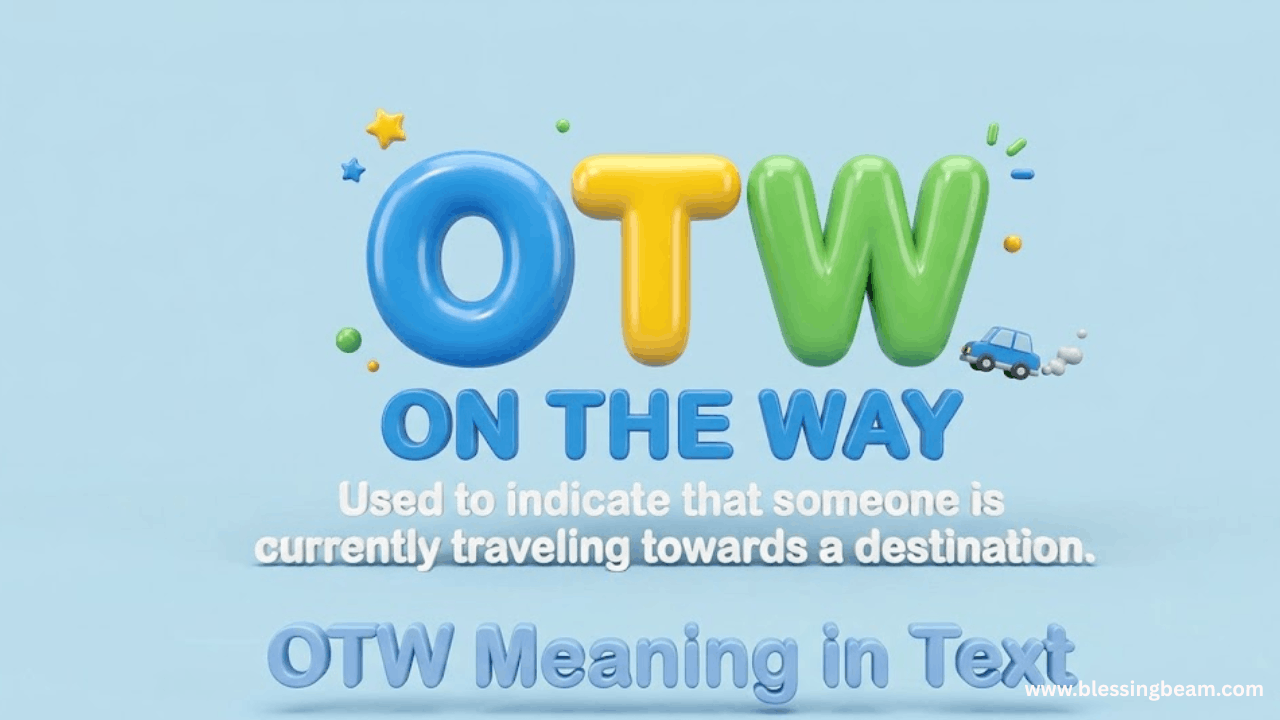
OTW stands for “On The Way.” It’s shorthand for telling someone you’re currently heading toward a location — their house, a meeting spot, work, or anywhere else you’ve agreed to be.
At its core, OTW is a status update. It tells the other person: I haven’t forgotten, and I’m already moving.
You’ll see it everywhere:
- “OTW, give me 10 minutes.”
- “Dinner’s otw, just placed the order.”
- “She’s otw to the airport rn.”
It works for people, packages, deliveries, and even abstract things like announcements (“new merch otw 👀”). That flexibility is part of why it’s stuck around since the early SMS days and never really gone out of style.
The abbreviation became popular for the same reason most texting shorthand survives: mobile keyboards used to be slow and clunky, and people needed a fast way to say “I’m coming” without typing the whole sentence. Even with full keyboards and voice-to-text now standard, OTW has stuck around purely because it’s quick, familiar, and universally understood.
OTW Meaning in Relationship
In relationships, OTW carries a little more emotional weight than it does in, say, a delivery notification.
When a partner texts “otw,” it’s often read as a small act of reassurance. It says I’m thinking about you and I’m already moving toward you — which, in a relationship, can feel comforting even if it’s just two letters and a “W.”
Context and tone shape how it lands:
- A simple “OTW 🙂” usually reads as warm and reliable.
- “omw, sorry I’m late again” can carry a slightly apologetic tone.
- A flat “otw” with no punctuation after an argument might feel cold or distant, even if that’s not the intent.
In dating specifically, OTW can pick up a flirty undertone, especially when it’s paired with playful emojis or sent in response to anticipation (“counting down till you’re here 😉 otw?”). The phrase itself isn’t romantic — it’s the surrounding tone, timing, and history between two people that turns it flirty, neutral, or distant.
The Most Common Meanings of “OTW” in Text
While “On The Way” dominates, OTW isn’t a one-trick phrase. Here’s a breakdown of its core meanings.
1. On The Way (Most Common Meaning)
This is the default interpretation in roughly 95% of cases. Someone is physically traveling toward a destination, person, or event.
Example: “Leaving the office now, otw.”
2. Leaving Right Now
Sometimes OTW is used the instant someone starts moving, almost interchangeable with “just left.” It signals the start of the journey rather than progress through it.
Example: “Otw, literally just grabbed my keys.”
3. Almost Arriving
In other cases, people use OTW closer to arrival, as a heads-up that they’re minutes away.
Example: “Otw, pulling into the parking lot.”
This is exactly why OTW timing confuses people — it can mean “I just started” or “I’m basically there,” depending entirely on who’s sending it.
4. Digital Arrival (Online Context)
Outside of physical travel, OTW often describes something that’s coming soon in a digital or non-literal sense — a product launch, a social media post, a notification, or content drop.
Example: “New video otw, stay tuned.”

How “OTW” Is Used in Real Conversations
OTW shifts personality depending on where it shows up. Here’s how it plays out across common platforms and relationships.
Also Read This: OML Meaning in Text: 2026 Ultimate Guide to What It Really Means in Chat, TikTok & Gen Z Slang
Friends & Casual Texting
Among friends, OTW is about as low-stakes as texting gets. It’s a quick status update, often with zero punctuation or context needed.
- “Otw, be there in 5.”
- “Yo where are you” → “otw lol traffic”
Instagram & Snapchat
On social platforms, OTW is used more loosely — sometimes literally, sometimes as a caption hyping up something that’s coming.
- A Snapchat caption: “otw to the concert 🎶”
- An Instagram comment: “this look is otw to becoming my whole personality”
Dating Apps
In dating conversations, OTW often appears when confirming a date or meetup, and tone matters far more here than on other platforms.
- “Excited! I’m otw 😊”
- “otw, can’t wait to see you”
Gaming & Online Communities
Gamers use OTW to say they’re joining a match, lobby, or call — not necessarily moving anywhere physically.
- “Otw to the lobby, give me 30 secs.”
- “Squad’s waiting, I’m otw.”
Work or Professional Chat
In casual workplace chats — Slack, internal messaging, or texts with coworkers you’re friendly with — OTW can work fine. In formal emails, it should be avoided entirely.
| Context | OTW Appropriate? | Better Alternative |
|---|---|---|
| Casual Slack message to a teammate | Yes | — |
| Text to your manager | Depends on relationship | “Heading there now, be there in 10” |
| Formal email | No | “I am currently en route and will arrive shortly” |
| Client-facing message | No | “On my way, see you soon” |
Is “OTW” Rude, Flirty, or Offensive?
OTW is neutral by default. It only takes on an emotional charge based on tone, punctuation, timing, and the relationship between sender and receiver.
When it feels positive:
- It reassures the other person you haven’t forgotten them.
- It reduces uncertainty when someone’s waiting.
- Paired with emojis, it feels warm and friendly.
When it can feel negative:
- A bare “otw” with no follow-up after being asked something urgent can feel dismissive.
- Repeated “otw” texts that never lead to actual arrival can damage trust over time.
- In a tense conversation, a short reply like this can come across as curt.
Flirty use:
In dating or romantic contexts, “OTW 😉” or “otw, can’t wait” can read as playful anticipation. It’s rarely the word itself doing the flirting — it’s the emoji, exclamation, or context wrapped around it.
How to Respond When Someone Says “OTW”
Your reply should match the tone and urgency of the conversation. Here are options across different situations.
Casual Replies
- “Cool, see you soon!”
- “Okay, no rush.”
- “Sounds good 👍”
Funny Replies
- “OTW since when, the Jurassic period?”
- “Define ‘on the way’ — are we talking minutes or hours?”
- “I’ll believe it when I see you.”
Neutral Replies
- “Got it, thanks for the update.”
- “Okay, I’ll wait here.”
- “Noted, see you when you arrive.”
Professional Replies
- “Understood, I’ll be ready when you get here.”
- “Thanks for letting me know — we’ll start once you’re in.”
- “Appreciate the heads-up.”
Common Misunderstandings About “OTW”
A surprising number of mix-ups happen around such a short phrase. Here are the most common ones.
1. Thinking it means something deep
OTW is logistical, not emotional. It does not carry hidden meaning by default — people sometimes overanalyze a plain status update as if it were a coded message.
2. Confusing it with other slang
OTW occasionally gets mixed up with “OTP” (One True Pairing) or “OTF.” These are unrelated terms with completely different uses, so context is the easiest way to tell them apart.
3. Assuming it always means immediate arrival
OTW doesn’t promise a specific timeframe. Someone can send it the moment they leave the house or right as they’re pulling up — the word covers the entire journey, not just the final stretch.
4. Overthinking tone
Because text strips out voice and facial expression, a flat “otw” can feel ambiguous. Most of the time, though, it’s simply efficient — not curt, not cold, just quick. If you’re unsure how a message was meant, it’s usually safer to ask directly than to assume the worst from three letters.
It also helps to remember that repetition shapes reputation more than the word itself does. If a friend says “otw” and consistently shows up fifteen minutes later, the phrase starts to mean something different coming from them specifically than it would from someone who’s always on time. The slang stays the same — your trust in the person attached to it is what actually shifts.
Similar Slang Terms You Should Know
OTW belongs to a small family of movement-related texting shorthand. Here’s how they compare:
| Term | Meaning | Typical Use |
|---|---|---|
| OTW | On The Way | General — people, objects, or events |
| OMW | On My Way | Personal — emphasizes “I” am moving |
| ETA | Estimated Time of Arrival | Used when a specific time is needed |
| BRB | Be Right Back | Short pause, not travel-related |
| OTF | On The Floor / On The Field | Context-dependent, less common |
The biggest point of confusion is OTW vs. OMW. They’re functionally the same, but OMW leans personal (“I’m omw to you”), while OTW can describe anything moving toward a destination, including objects (“the package is otw” works, while “the package is omw” sounds off).

OTW Meaning in Chat (Tagalog)
In Tagalog and Filipino texting culture, OTW carries the exact same meaning as it does in English: “On The Way.”
It’s extremely common across Messenger, WhatsApp, and SMS in the Philippines. A typical exchange looks like this:
- Friend: “Nasaan ka?” (Where are you?)
- Reply: “OTW na.” (I’m already on the way.)
Adding “na” emphasizes that the journey has already started, which is a common pattern in Filipino texting — pairing English abbreviations with local particles for emphasis. Whether chatting with friends, family, or coworkers, OTW functions as a quick, no-fuss way to give a location update without typing a full sentence.
When You Should Avoid Using “OTW”
OTW is convenient, but it isn’t always the right fit. Here’s when to skip it.
Professional settings
Formal emails, client communications, and official documents should always spell things out fully — “I am on my way” or “I will arrive shortly” reads more polished than shorthand.
Emergency or serious situations
In urgent or high-stress moments, clarity matters more than brevity. “OTW” doesn’t convey enough detail when someone needs to know exactly when you’ll arrive or what’s happening.
Cross-cultural chats
When messaging someone unfamiliar with English texting slang, it’s worth spelling out “on my way” at least once before defaulting to the abbreviation, especially in international or mixed-language group chats.
Sensitive conversations
If someone is upset, anxious, or waiting on important news, a bare “otw” can feel dismissive. A fuller sentence with reassurance tends to land better in emotionally charged moments.
Frequently Asked Questions
What does OTW mean in text? OTW stands for “On The Way,” used to say someone or something is currently traveling toward a destination.
Is OTW the same as OMW? Yes, both mean essentially the same thing. OMW (“On My Way”) feels more personal, while OTW is slightly more general and neutral.
Does OTW always mean someone left immediately? No. It can mean someone just started moving or is almost there — the word covers the whole journey, not a specific moment.
Is OTW used in gaming? Yes, gamers commonly use it to say they’re joining a match, lobby, or voice call.
Is OTW appropriate at work? Only in casual chats with coworkers you’re friendly with. Avoid it in formal emails or client communication.
Can OTW be flirty? Yes, especially in dating chats when paired with playful emojis or an excited tone — though the word itself stays neutral.
What does OTW mean in Tagalog chats? It carries the same meaning as in English — “On The Way” — and is often paired with “na” for emphasis, as in “otw na.”
Final Thoughts
OTW is one of those tiny texting staples that’s stuck around because it just works. Three letters, and you’ve told someone you’re moving, given them a timing cue, and offered a bit of reassurance — all without typing a full sentence.
The meaning rarely changes. What changes is the tone around it — the emojis, the relationship, the timing, the platform. Once you read those cues, “OTW” stops being confusing and starts being exactly what it was always meant to be: a fast, friendly way to say I’m coming.
Whether you’re texting a friend about dinner plans, replying to a date, joining a gaming squad, or messaging a coworker on Slack, the same three letters do the job. Learn the context around them, and you’ll never have to second-guess a text again.
