

Quick Answer: Samesies is a playful slang term meaning “me too,” “same here,” or “I feel the exact same way.” It expresses agreement or shared feelings in a casual, warm, and lighthearted tone — most commonly used in text messages, social media, and everyday informal conversations.
The Honest Reason You’re Looking This Up
You got a text. Someone replied “samesies” and now you’re here, either confirming what you already guessed or trying to figure out if there’s a layer underneath you missed.
There isn’t. Samesies is about as transparent as slang gets. It means what it sounds like: same. But like most single-word replies, the feeling behind it — the warmth, the humor, the connection — is where the real meaning lives.
This guide breaks down exactly what samesies means, where it came from, how it shows up in real conversations, and the handful of things people consistently get wrong about it.
What’s Really Going On When Someone Says It
At its core, samesies is a casual, affectionate echo. When someone says it, they’re telling you: I relate to that. I’m in the same boat. You’re not alone in this.
It’s not just agreement — it’s agreement with warmth baked in. The word itself is soft and slightly silly, which is part of the point. Choosing “samesies” over “same” or “me too” signals that the speaker is relaxed, friendly, and not taking themselves too seriously.
The term is informal and playful, used among friends or in casual conversations to show that someone shares the same feelings, thoughts, or experiences as the other person.
That combination — genuine agreement plus playful delivery — is what makes samesies feel different from other one-word replies. “Agreed” is formal. “Same” is neutral. “Samesies” has personality.
How It Actually Appears in Messages
Samesies is almost always a standalone reply or a sentence opener. You won’t typically find it buried inside a long paragraph. It does its job in one shot.
Common patterns:
- As a complete response: “Samesies.” / “SAMESIES.”
- Opening a thought: “Samesies, I have literally been in bed since noon.”
- Followed by an extension: “Samesies! I’ve watched that episode three times already.”
- Casual affirmation: “Oh my god, samesies — same exact thing happened to me.”
It appears naturally in real written contexts, from casual text chains to acknowledgments in published books, showing just how widely the word has embedded itself into informal English.
The capitalization and punctuation tell you something too. All caps (“SAMESIES”) suggests high energy or strong relatability. A lowercase period (“samesies.”) is deadpan, sometimes self-aware. An exclamation mark is the most common: enthusiastic, warm, uncomplicated.
Also Read This: TMB Meaning in Text: Why Everyone’s Using It (And When You Shouldn’t)
The Tone Is the Whole Thing
With samesies, tone isn’t a bonus feature — it’s the main event. The word carries lightness. That lightness changes the energy of a conversation.
Consider two responses to: “I’m exhausted and I haven’t even had coffee yet.”
- “Yeah, me too.” — Fine. Neutral.
- “Samesies, I’m running on spite and three hours of sleep.” — Warmer. Funnier. More connecting.
The playfulness of the word gives the other person permission to laugh a little, even about something frustrating. That’s a social skill hidden inside a six-letter word.
The term is similar to “ditto” and is often used as a one-word reply, but unlike ditto, it carries a distinctly casual and friendly energy that works best in relaxed conversations with people you’re already comfortable with.
When to Leave It Out
Samesies is specifically a casual-register word. It doesn’t belong everywhere, and knowing when to skip it matters just as much as knowing how to use it.
Situations where samesies doesn’t fit:
| Context | Better Option |
|---|---|
| Work email to a manager | “I agree completely.” |
| Expressing condolences | “I completely understand how you feel.” |
| Formal group chat | “Same here.” |
| Serious emotional conversation | Something more specific and thoughtful |
| First impression with someone new | Depends on their vibe — read the room |
The word signals informality. When the situation calls for professionalism, sensitivity, or gravitas, samesies undercuts the moment. It should only be used in casual situations and not with people who will judge you on vocabulary, such as a potential employer or someone you’re trying to make a formal impression on.
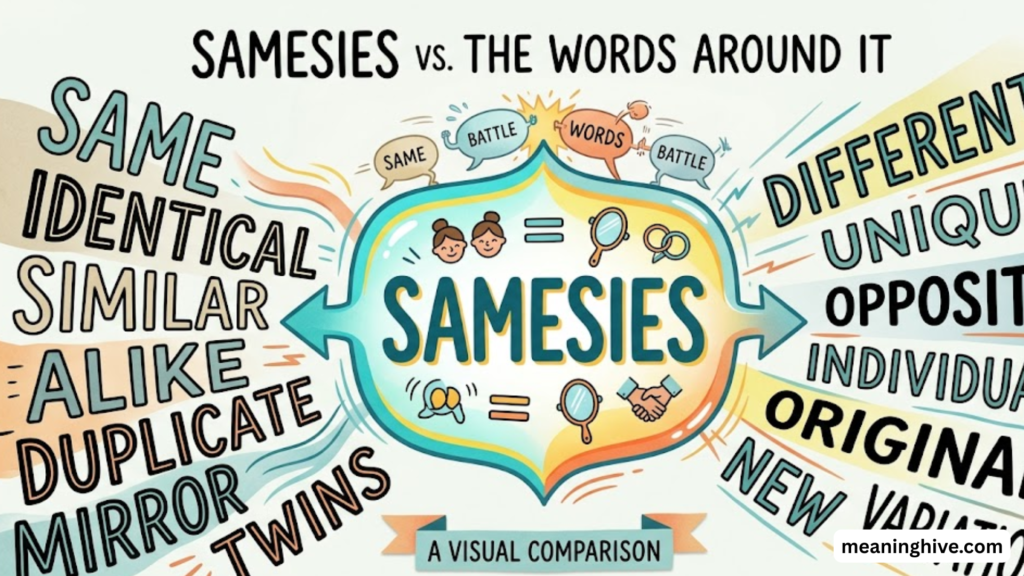
Samesies vs. the Words Around It
It helps to see samesies clearly alongside the expressions it’s often compared to:
| Word/Phrase | Tone | Best Used When |
|---|---|---|
| Samesies | Playful, warm, casual | Among friends, light topics |
| Same | Neutral, flexible | Any casual context |
| Me too | Straightforward | Agreement without emphasis |
| Ditto | Slightly retro, also casual | Agreeing with a full statement |
| Same here | Mild, semi-formal | Slightly more composed settings |
| Right back at you | Reciprocal | Returning a compliment or feeling |
| Totally | Enthusiastic | Agreeing with energy |
Samesies is simply a cooler way of saying “me too.” Other responses with a similar meaning include “Same here,” “Right back at you,” and “Ditto” — but samesies has a distinct warmth and playfulness none of those carry in quite the same way.
Real Examples — Different Situations, Different Feels
Here’s how samesies naturally lands across different conversation types:
Shared frustration:
“I can’t believe I agreed to plans for Saturday — now I’m dreading it.” “Samesies. Why do I do this to myself every weekend.”
Shared enthusiasm:
“I’ve been obsessed with that show for two weeks straight.” “SAMESIES. I finished it in four days and now I have nothing to live for.”
Mutual appreciation:
“I’m really glad we became friends.” “Samesies. Genuinely.”
Shared mood:
“I woke up inexplicably sad today.” “Samesies, no reason, just vibes.”
Mild complaint:
“Mondays should be illegal.” “Samesies. Someone please escalate this.”
Notice what each of these has in common: the person isn’t just saying “I agree.” They’re creating a small moment of connection. That’s the actual function of samesies in conversation — it closes the gap between two people quickly and without making a big deal of it.
A Few Things Worth Knowing
Where did samesies come from?
The word gained wide cultural visibility through the 2007 film Superbad, where Michael Cera’s character delivers the line “Samesies!” in an emotionally sincere scene — and a Washington Post critic noted at the time that if the moment hadn’t become a genuine catchphrase yet, it should. Urban Dictionary’s first entry for samesies appeared in September 2007, following the film’s release.
Before Superbad, the word existed in casual speech, but the film gave it cultural momentum. Google Ngram data shows a notable spike in usage during the early 2000s, with Millennials being the generation that first widely adopted the term.
Is it still used today?
Yes. While the term is most closely associated with Millennial slang, it hasn’t faded away. It circulates on social media, in texts, in comment sections, and in everyday conversation — particularly among people who grew up with it and kept it in their vocabulary.
Does it appear in formal dictionaries?
YourDictionary defines samesies as “(childish, informal) the same,” which captures its register accurately. Merriam-Webster has also tracked it under their “Words We’re Watching” series, acknowledging its genuine usage in mainstream English.
What People Get Wrong About It
Mixing it up with “samesy.” In some specific internet corners, “samesy” carries a different and more adult meaning. That’s a completely separate word in a different context. Samesies in a normal text conversation is straightforward playful agreement — nothing else layered in.
Thinking it only works for negative or complain-y things. People often associate it with shared misery (“ugh, same”), but samesies works equally well for positive shared feelings. Excitement, affection, enthusiasm — all fair game.
Assuming it sounds forced or try-hard. It only sounds forced if it’s performed rather than genuine. Slang used naturally lands well. Slang used to seem relatable to someone who doesn’t know you usually doesn’t. Samesies lands when it’s genuine. If you’re forcing it to seem chill or connected to someone, they’ll feel that.
Believing it’s gendered slang. There is no gender-specific meaning or use of samesies. Girls use it in the same way as guys or anyone else would, and the idea that it’s distinctly feminine slang is pretty outdated thinking at this point.
The Questions People Actually Ask
Can you use samesies sarcastically?
Yes, and it works well that way. The inherent playfulness of the word makes sarcasm feel lighter rather than cutting. “Oh, you also spent three hours doing a ten-minute task? Samesies.” The word absorbs the irony without making the other person feel bad.
Is it only for negative or complain-y things?
Not at all. It fits any shared feeling — excitement, affection, tiredness, craving for food, love of a show. If two people feel the same way about something, samesies applies.
Does it sound weird coming from a guy?
Not really. Whether it sounds natural depends on someone’s personal style and friend group, not their gender. Some guys use it naturally; others don’t — the same is true for women.
Samesies Meaning — Urban Dictionary
Urban Dictionary defines samesies as meaning “right back at you,” “me too,” or “ditto” — a term used to communicate that one sympathizes with, has committed similar actions as, or simply agrees with another person. The platform’s first entry appeared in September 2007, directly tied to the cultural moment created by Superbad.
Multiple entries on Urban Dictionary capture its range: from a “cooler way of saying me too” to a “pretty preppy, drawn-out way of saying same.” The variation in how people define it reflects how differently it lands depending on the speaker’s tone and context.
Samesies Meaning — Slang Urban Dictionary
As slang, samesies sits in a specific lane: casual, warm, slightly self-aware. The term is commonly used in casual conversations among friends or peers to express agreement or to show that you share the same sentiment — a lighthearted and playful way to connect with others and acknowledge that you have similar thoughts or feelings.
Slang dictionary sources consistently categorize it alongside “me too,” “ditto,” and “same here” — but note that samesies carries a softness and humor those alternatives don’t.
Samesies Mean Girls
While Mean Girls is often cited in the same breath as millennial slang, samesies is not from that film. The word’s mainstream breakthrough came through Superbad (2007), not Mean Girls (2004). The association likely exists because both films defined a specific cultural moment for the same generation and both dealt in sharp, memorable informal speech. But the line — and the cultural launch — belongs to Superbad.
The Short Version of Everything
- What samesies means: “Me too,” “same here,” “I feel the exact same way”
- Tone: Playful, warm, casual — never formal
- Origin: Popularized by the 2007 film Superbad; early 2000s Millennial slang
- Use it when: Texting friends, social media, casual conversation
- Skip it when: Work, serious emotional moments, formal settings
- Gendered? No. Anyone can use it
- Sarcastic use: Yes, works well because of the word’s built-in lightness
Samesies is a one-word reply that says: I get it, I’m in the same place, and I’m keeping this light. It’s warm without being intense, funny without trying too hard, and honest without requiring a paragraph. Use it when you mean it. Skip it when the room is too serious.
Frequently Asked Questions
What does samesies mean in a text? It means “me too” or “I feel the same way” — a casual, playful expression of agreement used in informal conversations.
Where did the word samesies come from? It gained wide popularity through the 2007 film Superbad, when Michael Cera’s character delivers it as a sincere one-word reply. Urban Dictionary’s first entry followed shortly after the film’s release.
Is samesies a real word? It’s recognized informal slang. YourDictionary includes it, and Merriam-Webster has tracked it under “Words We’re Watching.”
What is the difference between same and samesies? “Same” is neutral and versatile. “Samesies” is warmer, sillier, and more personal — it signals closeness and a relaxed conversational tone.
Can you use samesies in a formal setting? No. It’s strictly casual slang. In professional or formal contexts, use “I agree,” “same here,” or “I feel the same way.”
What does samesies mean in Urban Dictionary? Urban Dictionary defines it as “me too,” “right back at you,” or “ditto” — a casual expression of shared feeling or agreement.
Is samesies only used by girls? No. It’s gender-neutral slang. Anyone can use it depending on their style and social circle.
Can samesies be used sarcastically? Yes. The playful nature of the word makes it a natural fit for light sarcasm without sounding harsh.
What are synonyms for samesies? Me too, same here, ditto, right back at you, likewise, same, totally.
Is samesies related to Mean Girls? No. Its cultural origin is Superbad (2007). The Mean Girls connection is a common mix-up due to both films being Millennial touchstones.
